
RB2B AI: ASK US ANYTHING
The Hunter.io vs Apollo.io debate is a common one for B2B sales teams running outbound at scale. Both tools get the job done but they operate using static databases and cold outreach. This limits accuracy, timing, and visibility into client behavior. RB2B addresses these gaps by delivering real time intent data and buyer insights at affordable, transparent rates.
Trying to decide between Hunter.io vs Apollo.io for your outbound sales stack? You're not alone. Both B2B sales tools promise transformative results, but they serve very different processes.
Hunter works best for finding verified emails, while Apollo offers broader outbound intelligence features. Picking the wrong tool could severely limit how your team builds and scales outreach.
To help you make the right choice, we’ve analyzed both tool’s features, ideal use cases, and pricing. We also highlight their weaknesses and explore how RB2B may offer higher value for your team.
RB2B helps over 100,000 websites turn pageviews into pipelines. With the expertise of Adam Robinson, our founder, we help teams like Sendspark turn anonymous website traffic into revenue.

Our insights in this guide come from hands-on experience solving real-world challenges, rather than surface-level product claims.
Although Hunter.io and Apollo.io both support sales teams, they solve different problems in the prospecting workflow.
Hunter.io mainly focuses on contact and email discovery. It’s mainly used to find and verify professional email addresses and company domains. This makes it suitable for cold messaging when you’ve identified your target. But it falls short if you need intent data or account intelligence.
On the other hand, Apollo.io combines contact discovery and outreach tools with analytics and intelligence in one platform. It supports the full outbound motion, rather than just finding emails.
For more informed decision-making, we’ve compared both tools across seven of the most relevant criteria:
Let’s dive into both tools, comparing them across the different criteria.
Both tools help teams find and reach prospects, but take different approaches. Hunter makes speed a priority, while Apollo leans into an all-in-one workflow.
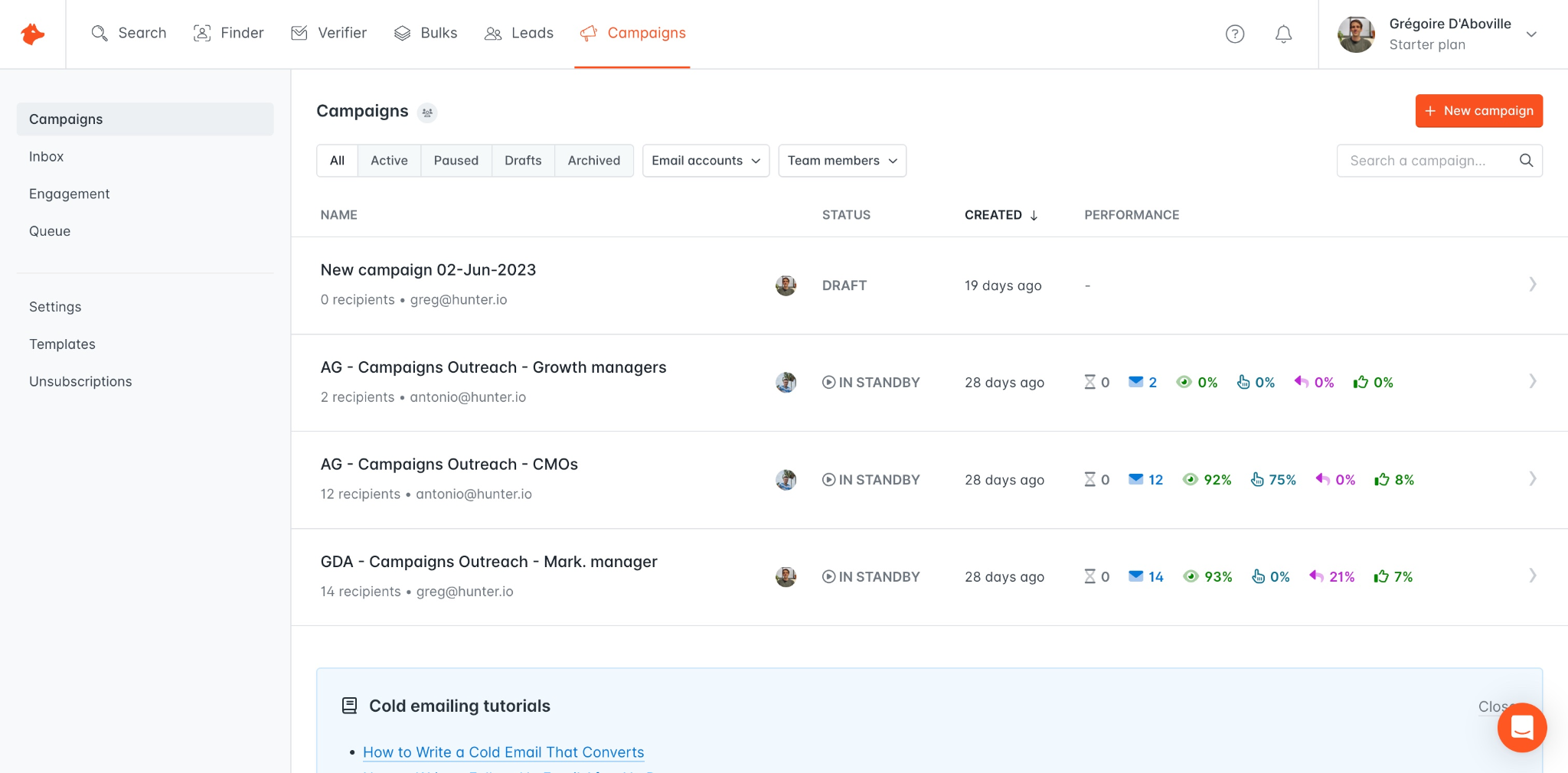
Hunter is a fast, reliable tool for finding and verifying professional email addresses. It aims to simplify how teams move from search to outreach. Its key features include:
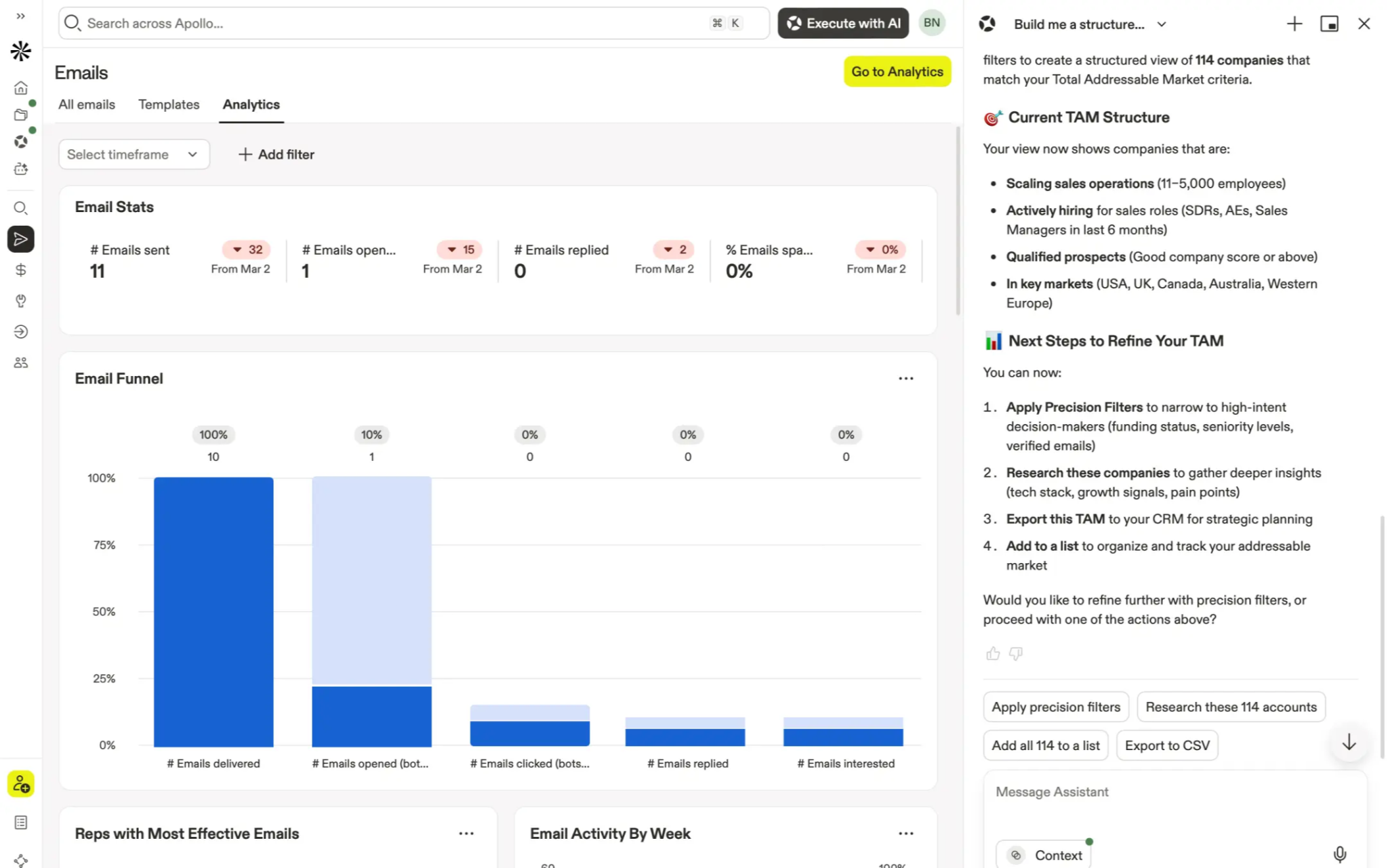
Apollo is an all-in-one prospecting and outreach tool. It provides contact discovery as well, but also supports the entire prospecting and outreach process from a unified platform. Its features include:
Their major difference lies in purpose and scope. Hunter is a focused tool for reaching decision-makers fast, but users note it lacks the feature depth needed for more complex outreach.
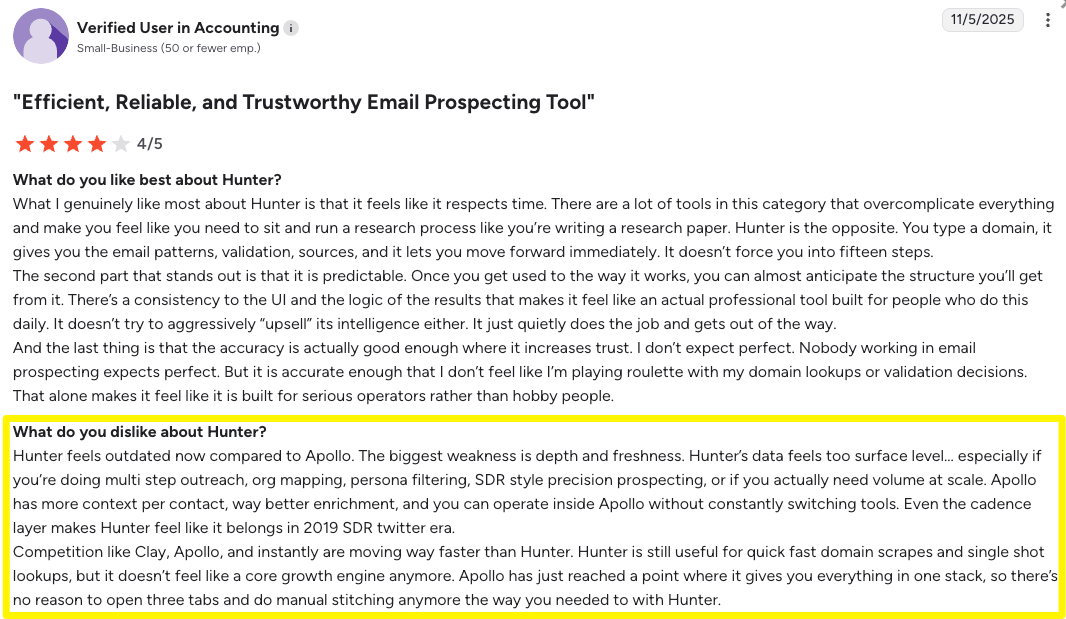
Most teams end up going with Apollo when they want a larger database and more capability built into one place. Ultimately, the better choice comes down to whether you need a simple email finder or a more comprehensive sales platform.
Hunter.io offers a focused database of over 100 million professional email addresses. Its coverage is strong for well-established companies, but it can miss contacts in smaller firms or niche markets where public data is limited.
As a full-functionality outbound platform, Apollo.io operates at a larger scale, with over 210 million contacts and 35 million+ companies, covering emails, phone numbers, and firmographic data. This broader reach makes it easier to build large prospect lists across industries and regions.
The trade-off is in how they target contacts. Hunter.io offers narrower but more precise coverage, while Apollo.io provides a wider database, making it better suited for high-volume prospecting.
Hunter.io prioritizes email verification and reliability, and this shows in its data quality. It pulls from public web sources and assigns confidence scores to each email, helping reduce bounce rates and improve campaign performance.
Meanwhile, Apollo.io's broader database means that accuracy is much more variable. Reviews often report solid results overall, but with frequent mentions of outdated or incorrect contact information within its large database.
Hunter offers fewer contacts with higher accuracy, making it the stronger choice when reliable data matters more. Apollo, on the other hand, provides much larger volume, but its accuracy fluctuates depending on the dataset.
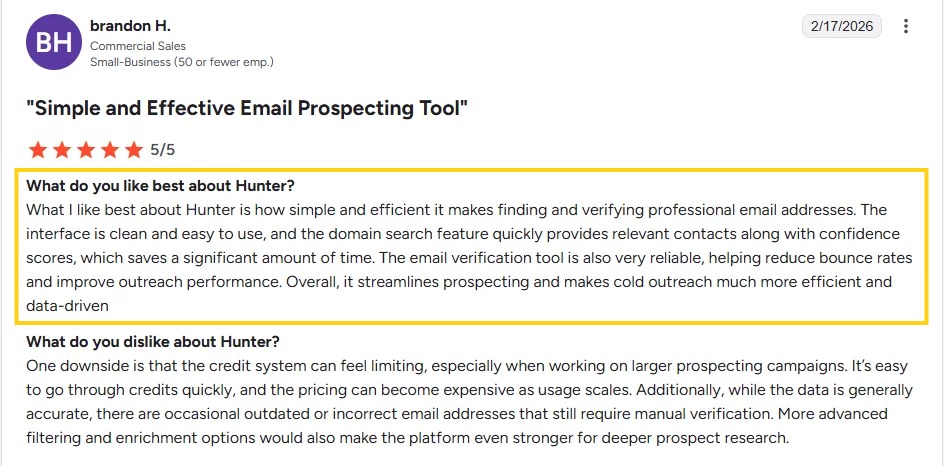
One consistent review Hunter.io gets is its remarkable simplicity and ease of use. Many users praise its clean interface, straightforward features, and easy learning curve. This minimalist design is a core advantage for small teams that want quick results with little configuration time or difficulty.
In contrast, Apollo.io’s additional functionality naturally creates a steeper learning curve. The depth of filters, automation, and sequencing enables stronger pipeline performance, but can also add more complexity, particularly when configuring workflows or integrations.
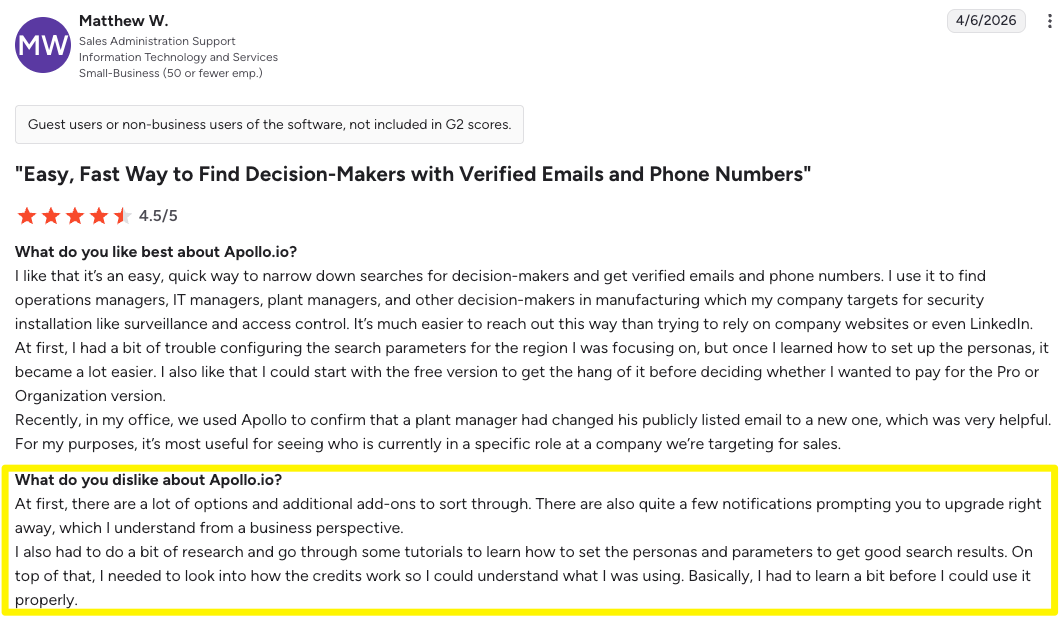
Both tools are relatively easy to master; however, if you need your team and system up and running in a short time, Hunter clearly wins.
Pricing determines how feasible a platform is, both for present and future use. In an ideal tool, as credit usage and the number of required seats increase, the cost must remain sustainable.
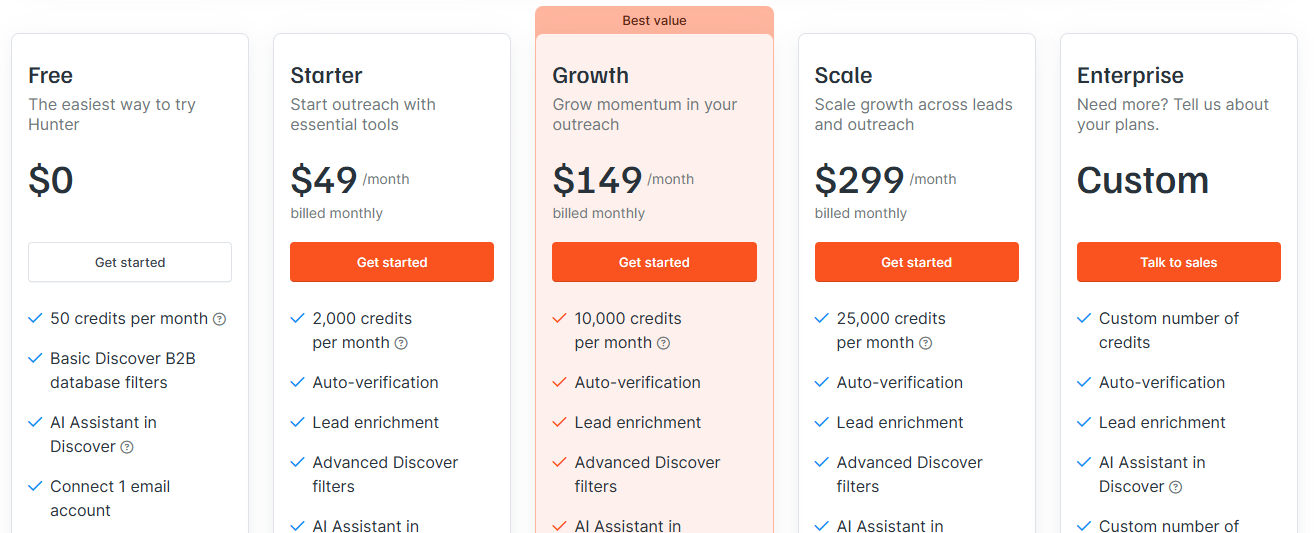
Here’s how their plans compare:
Hunter.io uses a tiered pricing model. Each plan gives a fixed number of monthly credits used for finding and verifying emails, with additional features unlocked as you move up tiers. Cost increases as credit grows, with a custom plan that allows tailored purchases according to enterprise team needs.
Apollo.io uses a seat-based + credit consumption model, where pricing increases with both users and usage. Each plan includes credits for accessing contacts, enrichment, and outreach features.
A 14-day free trial is available for higher tiers, which include more advanced automation and integrations. Add-ons are also available for $149, regardless of the chosen plan.
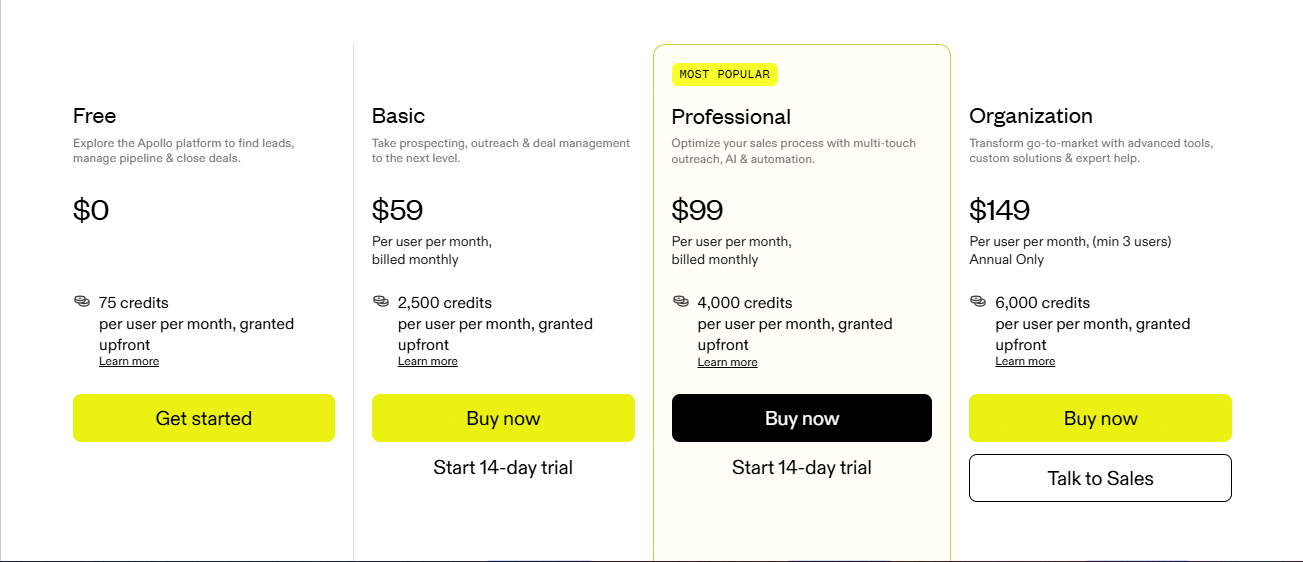
Both tools are relatively affordable. Apollo tends to offer better value due to its broader feature set, while Hunter can feel pricey for smaller sales teams. That said, Apollo's pricing gets less predictable as you scale. So the right choice still depends on your growth plans.
Hunter.io connects with a few popular CRMs such as HubSpot and Salesforce, email providers, and spreadsheet software. It also has a Chrome extension to enable lead generation while browsing. Users can search emails directly from LinkedIn or company websites and export straight into their outreach tools without extra steps.

Apollo.io also connects with these tools and has a Chrome extension, but with a wider ecosystem, boasting over 50 native integrations. These connections are designed to reduce manual work across prospecting, email marketing, and pipeline management.

In a nutshell, Hunter.io fits easily into existing workflows with minimal setup, while Apollo.io sits inside the entire sales process, linking prospecting, outreach, and CRM activity in one connected system. This makes it a stronger choice for teams that want a fully embedded, unified B2B workflow.
On G2, Hunter.io holds up well, with an overall rating of 4.4/5. Reviews mention clear communication, responsive support, and a helpful onboarding experience, though some users report slower resolution times or frustration around billing and credit policies.
Similarly, Apollo.io gets good recommendations, with a higher rating of 4.7/5 on G2. Users praise its all-in-one functionality and how support quickly resolves issues when they arise. However, reviews also note friction around pricing, feature paywalls, and occasional setup challenges.
To sum this point up, Hunter.io offers simple, reliable support, while Apollo.io provides more hands-on support for complex workflows.
How effective Hunter.io and Apollo.io are depends heavily on whether they’re ideal for your requirements.
If you need accurate emails but aren’t ready to manage a complex system, Hunter.io works best. But if you’re running high-volume outbound marketing campaigns. Apollo.io is the better choice. It combines prospecting, outreach, and pipeline tools in one place.
To evaluate the better fit, determine whether you value simplicity and precision or scale and functionality across your entire sales process.
Hunter.io and Apollo.io are effective for outbound prospecting but share an underlying limitation: guesswork. Both depend on static data and predefined targeting, which affects performance in multiple ways:
Hunter.io and Apollo.io focus on contact databases rather than real-time visitor identity. Prioritizing outbound means you’re often left guessing which company or firm in your niche is actually engaging.
Even when you identify the right company, you still have to reach out to multiple contacts to find the decision-maker. The result is slower outreach, limited relevance, and reduced pipeline efficiency.
Without clear signals, there’s a gap between email list-building and actual buying intent. Teams struggle to identify who to contact first, often engaging accounts that match their ICP but have no immediate need. This increases time spent on low-quality leads while high-potential prospects are missed, lengthening sales cycles but reducing conversion rates.
Both platforms scale costs with usage, whether through credits or seats. As outreach volume increases with higher traffic and company growth, so does the cost of maintaining campaigns.
This makes it harder for smaller teams to scale consistently, especially when results depend on high-volume outreach. It’s difficult to plan around a platform when you can’t definitively predict what it’ll cost you within a few years of use.
Hunter.io and Apollo.io rely on periodically updated databases, meaning the accuracy of their data depends on how recently a contact or company record was refreshed. But, in fast-moving industries, job changes, role shifts, and company restructuring can quickly make data outdated.
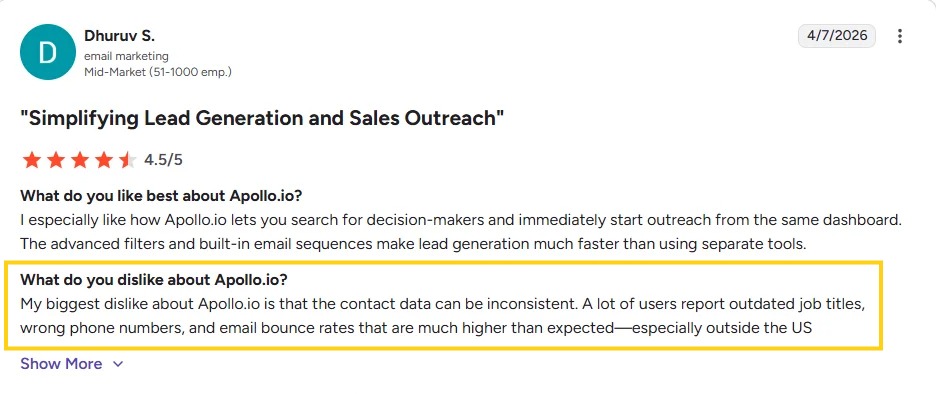
By the time sales reps act on a lead, the underlying information may already be stale. That means the team spends time reaching out to contacts who are no longer relevant, responsive, or even at the same organization.
RB2B is a website visitor identification platform built to solve the limitations sales and growth teams face with outbound messaging. Instead of building lists and hoping for replies, it gives you live intent signals without complicating your workflow using these features:
Hunter.io and Apollo.io start with a list. You pick a company, pull contacts, and send cold messages that may not receive responses.
RB2B removes this guesswork, identifying individual visitors on your site, their name, role, company, and LinkedIn profile without breaking GDPR and CCPA compliance laws. For example, instead of pulling five contacts from Apollo for a target account and sending a sequence, you might see that a “VP of Growth at X SaaS company” spent 6 minutes on your product page.
This way, instead of one-size-fits-all generic messaging, you can customize emails to be more relevant to your target.
Hunter and Apollo work with databases, and while they provide contact information, they don’t analyze buyer behavior or tell you when someone is in-market.
Meanwhile, RB2B works in real time. When someone lands on your site, you see it instantly, often pushed straight to Slack, CRM, Teams, or your other work tools. You learn what pages they visited, how long they stayed, and whether they came back.
Armed with this information, you can immediately send more specific and timely messages that are more likely to get your target’s attention and lead to conversions.
Outbound tools leave the bulk of lead prioritization to the user. Although you filter by title, company size, or industry, everyone on the list looks similar. There’s no clear signal for who to contact first.
RB2B solves this with behavioral prioritization. Features like Hot Leads and Hot Pages show which visitors are most engaged. Multiple visits, time on high-intent pages, and repeat sessions all signal stronger interest.
This system helps you rank your leads and immediately focus efforts on the accounts already showing buying signals, instead of working through an entire spreadsheet. For instance, if two companies match your ICP but one has visited your site three times that week and viewed your demo page, that’s the one you prioritize.
By doing this, you spend less time on low-intent outreach and more time closing warm inbound leads.
Hunter and Apollo have similar, usage-based pricing structures. In both cases, costs are tied to how many people you contact, whether those people are actually interested or not. With growth, even the most affordable plans can become unsustainable using this model.
RB2B flips that, going beyond lower cost per contact to improve cost per opportunity by focusing only on high-intent visitors already engaging with your site.
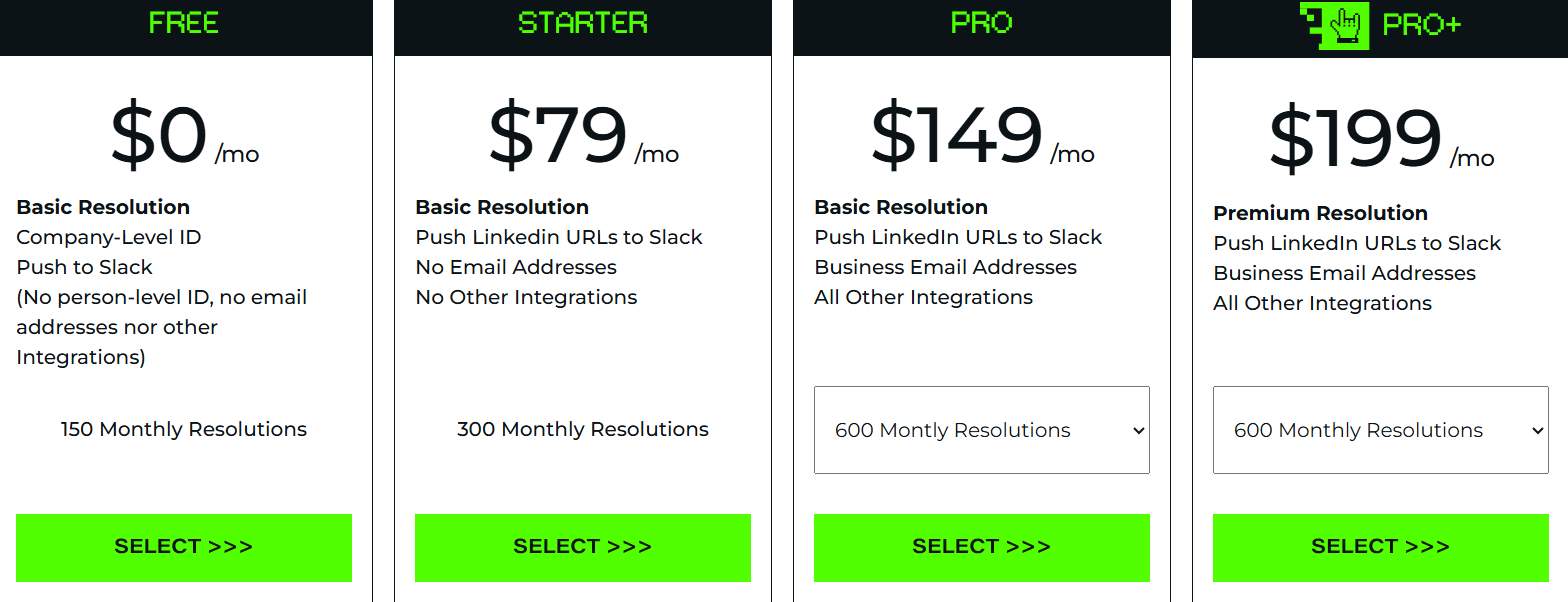
Instead of paying for outreach volume only, it charges based on monthly visitor resolutions or the number of website visitors it successfully identifies at the company or person level.
This lets you invest in signals that are far more likely to convert. You also get a forever-free plan to test the software and 7-day full-featured free trials for the paid plans. RB2B’s pricing structure includes:
Many outbound tools take time to set up and maintain. You need to configure data sources, build lists, set up sequences, connect your CRM, and manage credits. This can quickly get overwhelming, reduce workflow efficiency, and slow your team down.
RB2B’s setup and operation are much faster and require little effort. You install a simple tracking pixel, integrate your tools seamlessly, and it begins identifying visitors right away. There’s no list building or manual data enrichment needed as data flows automatically into your CRM or Slack, so your team can act without delay.
In addition to its straightforward setup, you get a responsive support team to walk you through any bottlenecks and ensure you get immediate value for your purchase.
Hunter.io and Apollo.io have unique functionalities in verifiable email finding and full-scale outbound prospecting respectively. While both tools have their merits, their focus on list building and outbound means that users lose time chasing cold leads even as costs rise with usage.
RB2B changes the narrative by showing you who is already visiting your site in real time, down to the person level. It moves you from basic cold messaging to high-intent intelligence and conversation that drives pipeline conversions and revenue without complications.
See exactly who is visiting your site and turn intent into sales. Sign up with RB2B today!
Hunter.io is mainly an email finder used to quickly discover and verify professional email addresses. On the other hand, Apollo.io is a broader outbound platform that combines contact data with sequencing, CRM tools, and sales engagement features.
It depends on your workflow. Apollo.io is a stronger choice for teams that want an all-in-one outbound system for prospecting and outreach. Hunter.io is better if fast, accurate email discovery with minimal complexity is your priority.
Apollo helps you build outbound lists and run campaigns, while RB2B shows you who is already visiting your site. Instead of cold outreach, RB2B enables intent-driven sales based on real-time behavior. It helps teams prioritize warmer leads before running traditional outreach campaigns.
Both tools rely on static databases, which means they don’t show real-time buying intent. You still have to guess who is actually interested in your product and when to reach out.
Apollo helps you build outbound lists and run campaigns, while RB2B shows you who is already visiting your site. Instead of cold outreach, RB2B enables intent-driven sales based on real-time behavior. It helps teams prioritize warmer leads before running traditional outreach campaigns.
Alert your reps, start automated outreach, and add to lead score in under five minutes.

