
RB2B AI: ASK US ANYTHING
If your team needs to verify email addresses at scale and you are considering Hunter.io, it offers different plans. But the important thing to learn is which types of teams each plan is best suited for. So, you can choose the option that aligns with your team's outbound stage and budget.
But if you're exploring other sales or marketing tools, visit the RB2B blog. We regularly review popular platforms to help GTM teams make informed purchase decisions.
Reaching the right person is half the battle in outbound sales. Imagine your team guesses an email alias like jane@company.com, only to discover it belongs to Jane in customer support. Not Jane, the content marketing manager you were trying to reach. Suddenly, hours of research, personalization, and follow-ups have been directed to the wrong person.
If you’re tired of losing time and momentum to guesswork or manual email sourcing, it may be time for a better approach. A dedicated email finding and verification tool can solve that problem. This increases your chances of landing in the correct inbox, where real conversations and potential customers await.
If your search has led you to Hunter.io and you're evaluating the cost implications, this pricing review will give you the clarity you need. Below, we will break down Hunter.io's pricing, So, you can decide whether it's the right investment or if an alternative like RB2B, which offers deeper lead enrichment, is a better fit for your team.
But first, does investing in Hunter.io align with your current business needs?
Hunter.io is a widely recommended tool for teams that need to find or verify email addresses before sending outbound messages. But purchasing it solely for email finding or verification may not deliver the best ROI. To get the most value from Hunter.io, your team should use its full outbound features, which include:
If your team mainly uses LinkedIn and doesn’t run large outbound email campaigns, Hunter.io may not be worth the cost. It’s also less ideal if you only need email verification. In these cases, exploring alternative tools or continuing with your existing tech stack might be a smarter choice.
Adam Robinson founded RB2B after seeing how legacy ABM tools fall short. They often target the right company but miss the actual decision-makers within it. Our contact-level identification tool closes that gap by revealing the individual behind intent signals, not just the company. This removes guesswork for sales and marketing teams.
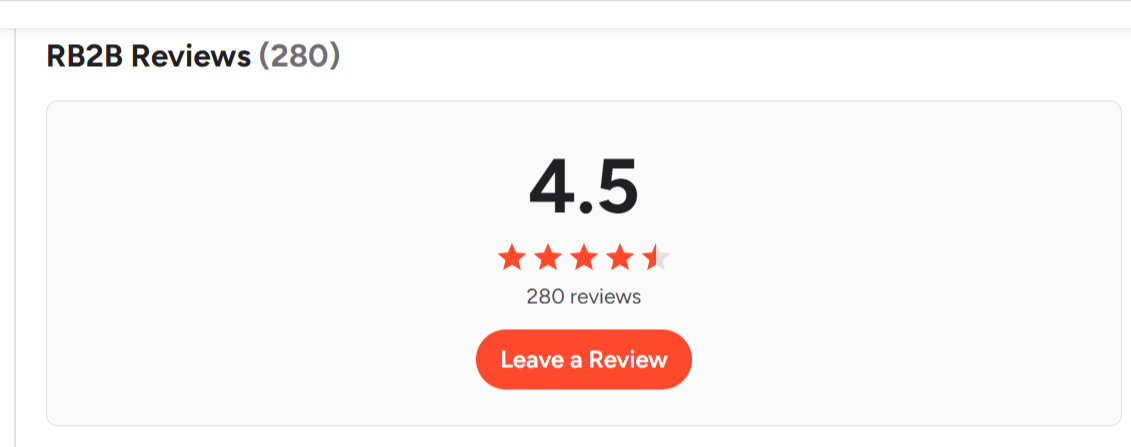
Through continually improving RB2B and supporting our users, we've gained deep insights into the challenges popular sales and marketing tools like Hunter pose. This review draws directly from that experience. Besides, With over 1,500 happy customers and a 4.5/5-star rating on G2, you can trust what we have to say.
According to Hunter.io's pricing page, there are five plans, Free, Starter, Growth, Scale, and Enterprise. Each plan varies by monthly credits, connected email accounts, and recipients per email sequence.
P.S. Credits are used to find email addresses (1 credit per email) or verify them (0.5 credits per email).
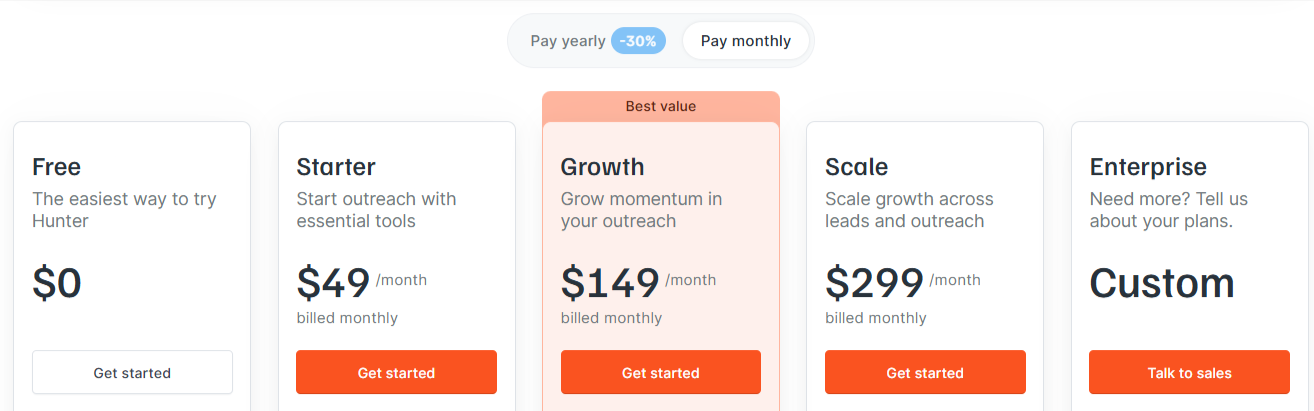
Here is a comparison table outlining what each Hunter.io plan includes and the type of team it's best suited for:
All Hunter.io's paid plans include core features like ICP discovery, lead enrichment, auto-verification, AI writing assistant, and priority support. The free plan, however, includes only ICP discovery and standard support.
Each plan, including the free tier, allows unlimited team members. But only paid plans permits you to connect additional email accounts (+$10/month per account) or purchase extra credits.
Extra credit pricing varies by tier, such as:
Enterprise users also receive a dedicated account manager.
P.S. Paying annually saves 30% on any paid plan.
Now that you understand what Hunter.io will likely cost your team, here are some important limitations to consider before clicking "Get Started.:”
After defining your ideal customer profile (ICP) criteria, Hunter.io surfaces matching companies. But not the specific individuals within those companies who are actively showing buying intent. This means your team still has to determine which person inside that organization is actually interested in your solution.
Hunter.io does allow you to find email addresses for potential contacts within the surfaced companies. However, it doesn't tell you which of those individuals is the true intent-driven lead.
To increase your chances of reaching the right person, you may need to email multiple stakeholders within the same company. This wastes credits, time, and effort while still relying on guesswork.
When matching company data to your ICP criteria, Hunter.io primarily uses third-party signals like new ICP hires, hiring/funding announcements, and new technology adoption.
These signals can provide some insight, but they are usually weaker indicators of purchase intent. First- or second-party signals, like webinar signups, website visits, product page engagement, or competitor research, are more reliable.
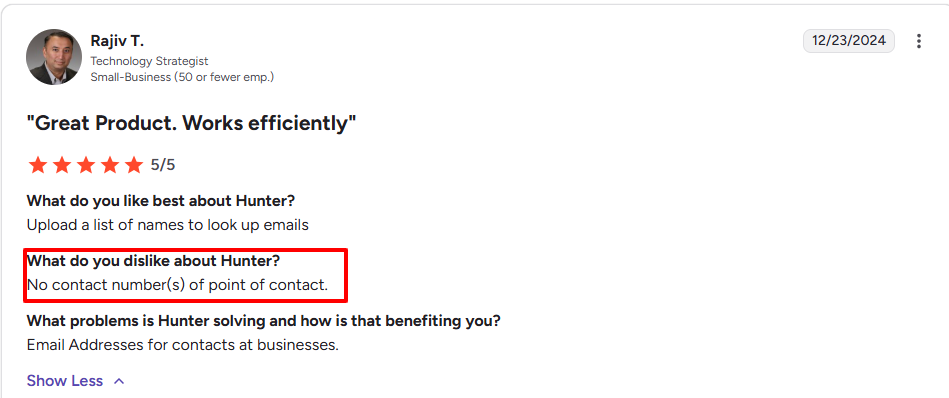
If your team uses multiple outreach channels, like phone calls or LinkedIn DMs, Hunter.io may feel limiting. The platform provides verified email addresses but does not include phone numbers or LinkedIn profile data.
Just as this user stated on G2:
If the limitations of Hunter.io above are deal-breakers for your team, here are three alternatives worth considering:
RB2B is a contact-level website visitor identification tool for sales and marketing teams. It reveals the actual stakeholders visiting your site, not just the companies they work for. Instead of stopping at company identification, RB2B reveals the individuals engaging with your brand, allowing you to act on real buying intent.
Compared to Hunter.io, RB2B offers the following benefits:
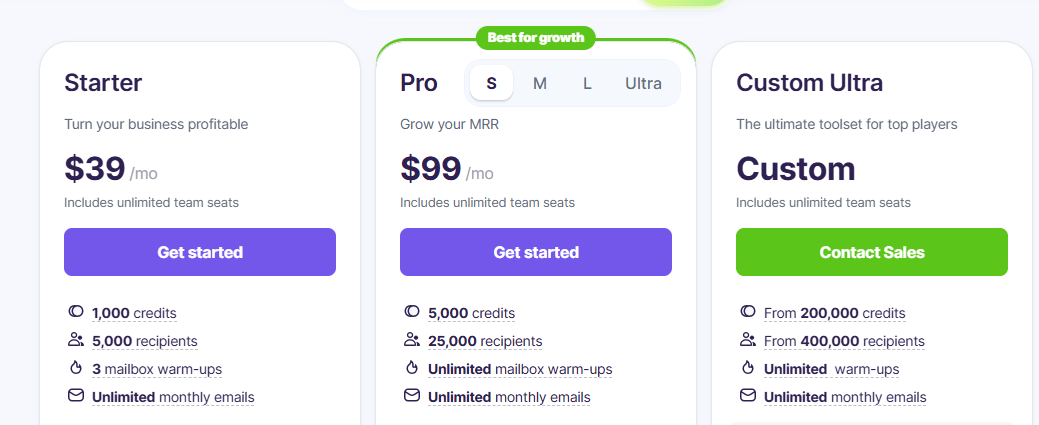
RB2B provides3 paid plans:
RB2B also offers a freemium plan that allows you to identify up to 150 companies per month. To try out RB2B, sign up for our 7-day full-feature trial.
Apollo is a comprehensive, AI-powered go-to-market (GTM) platform designed to support outbound prospecting, inbound capture, data enrichment, and data execution, all in one system.
It helps modern sales and marketing teams unify their GTM efforts and ensure every team member focuses on high-impact activities. Instead of stitching together multiple tools, Apollo combines data sourcing, outreach, dialing, enrichment, and CRM functionality, potentially saving teams thousands of dollars annually.
Unlike Hunter.io, Apollo:
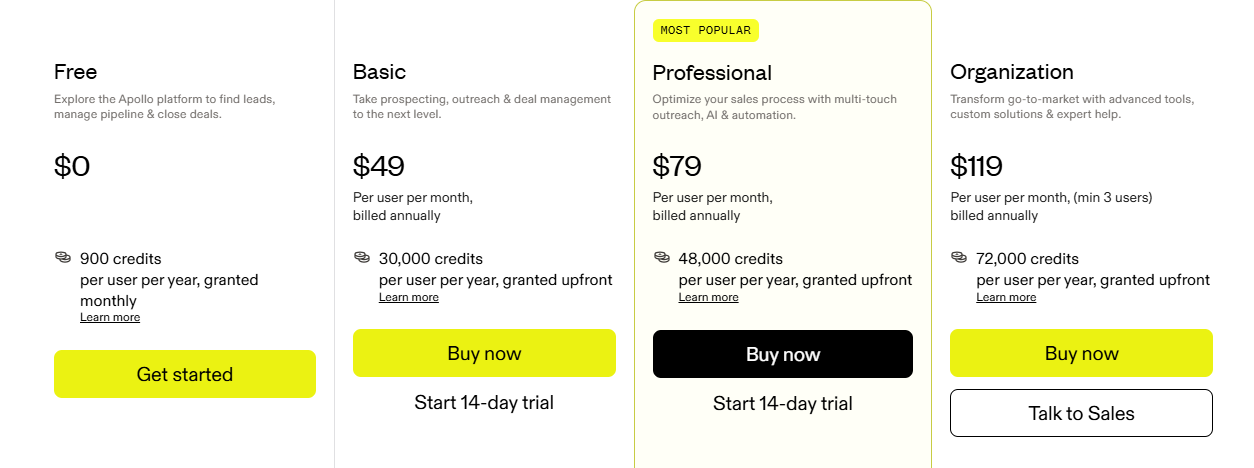
Apollo offers a free plan and three paid tiers.
Snov.io helps B2B teams scale both email and LinkedIn outreach from a single platform. With Snov.io, teams can discover new prospects, verify email addresses, send personalized emails and LinkedIn messages, and segment and manage leads efficiently.
Like Hunter.io, Snov.io primarily provides contact-level ICP identification and does not leverage strong first-party intent signals, like website visits.
Unlike Hunter.io, Apollo:
Snov.io uses a credit-based pricing model and offers three paid plans to suit different outbound team needs.
Choosing the right outbound tool isn't just about price; it's about aligning features with your team's workflow, scale, and outbound channels. If your outbound strategy relies mainly on email, Hunter.io can be a solid option. This works best if you're comfortable manually narrowing down the right contacts within each company.
But if you want to skip the guesswork and reach the actual decision-makers showing intent, RB2B offers a major advantage. By providing verified email addresses and LinkedIn profiles, along with tracking strong first-party signals like website visits, it lets your team act on real buying intent immediately. This saves time, boosts engagement, and maximizes ROI.
Want to see exactly how RB2B does this? Try our 7-day full-feature trial today.
Alert your reps, start automated outreach, and add to lead score in under five minutes.

