
RB2B AI: ASK US ANYTHING
Account-based marketing (ABM) promises numerous benefits, like higher conversion rates, better sales and marketing alignment, smarter personalization, and clearer attribution. But most teams that adopt it don't see those advantages. RB2B closes this gap between execution and results with accurate, real-time intent data.
Most B2B growth teams aren't short on activity; they're short on coordination.
Marketing captures leads, while sales runs outbound. But results don't compound because efforts are fragmented: leads are treated individually, timing is guesswork, and past account interactions rarely inform the next touch.
ABM promises to fix this, but there’s a clear problem. While 71% of B2B teams say they use it, just 47% of those adopters admit proving its ROI is still difficult. So, are they actually seeing results, or is it just hype?
This article breaks down 9 core benefits ABM delivers over traditional approaches, and how to set up your ABM program to get real results.

At RB2B, we’ve worked with over 100,000 B2B teams to uncover the identity of their website visitors at both the individual and company level. Our extensive experience successfully supporting and enabling account-based marketing for B2B businesses has given us valuable knowledge on its benefits and implementation.
Adopting account-based marketing (ABM) means shifting from broad, volume-based tactics to a focused, intent-driven approach centered on high-value accounts. Here are nine proven benefits that make ABM worth it.
Most teams try to improve conversion rates by refining messaging or increasing outreach volume. But conversion is often less about messaging and more about timing. Even the most personalized message won't convert someone who isn't ready to buy, while a simple message can convert a buyer who is already in-market.
ABM, however, focuses your efforts on accounts that are already showing buying intent, instead of casting a wide net. For example, if multiple stakeholders from the same company visit your pricing page several times within a week, that's a strong signal they are evaluating vendors.
By identifying and engaging these in-market accounts at the right time, ABM software naturally increases conversion rates. Without real-time intent data powering this, this timing becomes guesswork, and teams revert to volume instead of precision.
In traditional lead-based models, sales and marketing teams often operate with different definitions of a "qualified" lead. Marketing may pass along leads based on light engagement, like downloading an ebook, while sales sees those same leads as unready to buy. This results in friction and wasted outreach between the teams.
ABM changes this dynamic by aligning both teams around shared accounts, signals, and goals. Instead of debating lead quality, sales and marketing work from the same pool of high-value accounts and evaluate them using the same intent data, driven by visibility.
For example, if an account shows consistent engagement across emails, product pages, and webinars, RB2B lets both teams clearly see that momentum and act accordingly. This shared visibility removes guesswork, eliminates low-quality handoffs, and creates a unified revenue team focused on engaging accounts that are actually moving toward a purchase.
Traditional lead-based outreach often prioritizes volume; sending as many messages and making as many calls as possible in the hope that some will convert. But this approach is inherently inefficient because the target lists are often built from generic databases or vague criteria that don't reflect real buying intent.
ABM eliminates this inefficiency by focusing only on accounts that are actively showing intent. Instead of static lists, your teams build account lists using real-time intent data. They reprioritize them based on recent activity, pause outreach to inactive accounts, and double down on accounts showing strong buying signals.
As a result, your team spends less time chasing cold prospects and more time engaging accounts that are actually in-market, leading to better outcomes with fewer resources.
For most B2B buyers, timing plays a critical role in how quickly a deal closes. Engaging too early means spending weeks or months nurturing a prospect who isn't ready to speak with sales. Engaging too late means competing with vendors who already have mindshare, making the deal harder and slower to win.
ABM helps you shorten your sales cycle by aligning outreach with real-time intent signals. Effectively, outreach is triggered immediately after high-intent actions, like increased activity over a short period. That means skipping unnecessary early-stage education for buyers who are already informed and actively evaluating solutions.
ABM platforms like RB2B also give you a first-mover advantage in competitive deals. By identifying early-stage research behavior, like initial visits from new accounts or engagement with educational content, you can engage prospects before competitors even enter the conversation. The result is a shorter, more efficient sales cycle.
Most sales outreach personalization rarely goes beyond surface-level details like a first name, job change, or recent promotion. In many cases, these data points are no more effective than a generic message, despite the effort and tools used to gather that data.
Instead of relying only on demographic or firmographic data, RB2B’s ABM software gives your team visibility into how accounts actually engage with your brand. It also captures every interaction across marketing and sales, creating a complete picture of each account's journey.
For example, if a prospect repeatedly visits your implementation or integration pages, you can reach out with a guide tailored to their team's likely setup. If they engage with demo-related content but don't book a call, you can follow up with a relevant demo recording.
ABM ensures your messaging reflects what buyers care about now, instead of generic facts that don't influence purchasing decisions.
For teams handling large volumes of leads, it's common to prioritize outreach based primarily on how closely a prospect matches ICP criteria. While this seems logical, it often overweights fit and ignores intent. As a result, accounts that look perfect on paper but show little real interest are pushed to the top of the queue.
ABM solves this by combining both dimensions: ICP fit tells you who could buy, while intent signals tell you who is ready to buy. In practice, RB2B prioritizes high-fit, high-intent accounts, while others are ranked dynamically based on ongoing activity. Signals like engagement recency, depth of page visits, and repeated sessions help continuously re-rank accounts.
This approach ensures your team focuses on accounts that matter right now, not just those that look good on paper, leading to more efficient outreach and better conversion outcomes.
Many B2B sales motions make the mistake of focusing on a single contact. In reality, most B2B purchases involve multiple stakeholders with different priorities and influence. Relying on one contact limits your visibility into the decision-making process and weakens your ability to shape the outcome.
ABM shifts this approach by treating the account, not the individual, as the prospect. It tracks and consolidates engagement across multiple stakeholders within the same company, giving your team a clearer picture of collective buying intent.
For example, a CTO exploring API documentation, a marketing leader reviewing use cases, and a RevOps manager checking integrations all signal coordinated evaluation. These diverse interactions indicate a deeper, more serious buying process than a single-threaded interaction ever could.
RB2B lets you engage multiple stakeholders and address their specific needs, so your team can navigate internal dynamics more effectively, handle objections earlier, and build a stronger consensus. This broader influence increases the likelihood of closing not just deals, but larger, more strategic ones.
Attribution is often unclear, even for teams using advanced analytics tools. It's difficult to pinpoint exactly what influenced a prospect's decision to buy. As a result, many teams default to last-touch attribution, crediting the final interaction before conversion.
But in truth, B2B buyers engage with multiple touchpoints before making a decision. Relying on last-touch attribution can be misleading, causing teams to overvalue certain channels while overlooking others that quietly influence purchase decisions.
ABM improves attribution by giving you a complete, account-level view of engagement across the entire buyer journey. Instead of isolated touchpoints, you see activity build over time, from initial engagement to opportunity creation and, eventually, closed revenue.
RB2B, for instance, lets you track how account engagement translates into pipeline, and connects website activity directly to deal progression. You can then analyze patterns across closed-won accounts, like repeated visits to specific product pages or consistent engagement with certain content, and identify what actually drives conversions.
Traditional outbound often feels disruptive because it reaches buyers without context. Messages land when there's no active need, making even well-crafted outreach feel irrelevant or intrusive.
ABM changes how outreach is perceived by grounding it in real buyer behavior. Instead of initiating conversations from a cold start, your team engages accounts that are already interacting with your brand. This shift makes outreach feel timely and relevant, with buyers more likely to respond because the conversation aligns with their intent.
Over time, this changes how your brand is experienced in the market. Instead of being another vendor pushing messages, you show up as a relevant participant in an active buying journey. When outreach is triggered by real-time intent signals, it aligns with existing interest instead of competing for attention.
Even though the majority of B2B brands have adopted ABM, proving ROI from their ABM programs remains a major challenge. This is usually because of a few foundational execution issues:
ABM is built on the idea of focusing attention on a carefully selected set of ICP accounts with the highest likelihood of conversion. But when that ICP definition is unclear, the entire strategy starts on weak ground.

In that case, teams end up investing time, budget, and effort into accounts that were never likely to convert in the first place—regardless of how many messages they receive or how many channels they are contacted via.
When your ICP criteria are poorly defined, your entire ABM program is set up for failure from day one.
Demographic fit is useful, but it should never be the only factor when selecting accounts for an ABM program. A company may look like a perfect ICP match on paper, right industry, size, and structure, but still be completely out of the market.
The issue is that fit doesn't tell you timing. An account might match your ideal profile but not yet recognize the problem your solution solves, or may not even be aware that a solution like yours exists.
If you include these accounts purely based on demographic alignment, without any signal of purchase readiness, your ABM efforts will likely stall. You end up investing time and budget into accounts that aren't actively evaluating solutions, which lowers engagement and weakens overall campaign performance.
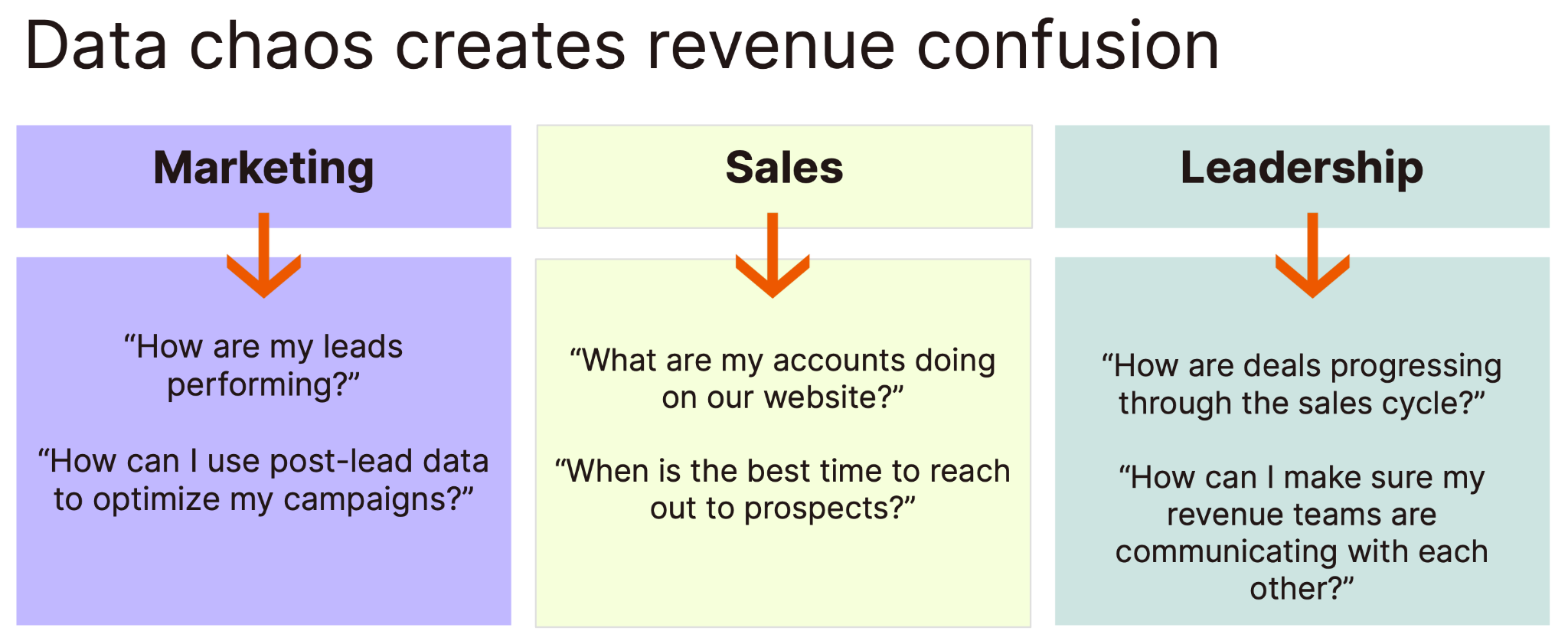
ABM works best when every interaction with an account is visible, connected, and used to inform the next step. This means having a unified view where marketing can see visited pages and engaged campaigns, while sales can view outreach history, responses, and deal progression.
This way, every team is acting on the same current signals and can build on each other's efforts rather than working in isolation. When that visibility is missing, each team operates based on assumptions rather than real account history.
For example, one rep might assume an account is cold and restart top-of-funnel outreach, while another assumes it is already sales-ready and pushes for a demo. Neither action might align with the account's actual journey, leading to inconsistent messaging and wasted effort.
Even when ABM efforts successfully convert accounts, many teams fail to capture what actually drove those wins.
Without visibility into which messages, channels, timing, or touchpoints contributed most to the outcome, it becomes difficult to replicate success. Each new account effectively becomes a fresh experiment rather than a repeatable system built on proven patterns.
For example, a deal might close after a combination of email outreach, a product demo, and multiple website visits—but if there's no structured way to analyze which interaction mattered most, that insight is lost.
This lack of learning slows down performance over time. As a result, it becomes harder to scale ABM efforts.
First-mover advantage plays a major role in B2B sales. Even when an account is a perfect ICP fit and shows strong intent signals, delayed engagement can significantly reduce your chances of closing the deal.
In many cases, buyers don't wait. If your team is slow to act, competitors who respond faster can step in, shape the conversation, and influence the decision early in the buying process. By the time you reach out, the account may already be leaning toward another solution.
This reduces both conversion rates and the overall effectiveness of your ABM program.
To build a successful ABM program, you need to actively avoid the common pitfalls that cause most strategies to underperform. Here are five best practices to guide that approach.
A strong ABM strategy starts with a clearly defined ICP. You need to know exactly who benefits most from your product or service, including their role, company size, industry, location, and key pain points.

However, the ICP definition shouldn't be overly restrictive. Many teams limit themselves to "perfect" enterprise buyers and end up ignoring smaller or non-traditional accounts that are actually ready to convert. Effective ABM includes all potential buyers who show real alignment, not just the most obvious ones on paper.
You can identify your ideal buyers by digging into your CRM for companies that were easy to convert and are benefiting significantly from your product.
A strong ABM strategy doesn't treat demographic fit and intent as separate filters. Instead, it combines both, with intent often carrying more weight when prioritizing accounts. This ensures you're not just targeting companies that match your ICP on paper, but those actively showing signs of readiness to buy.
After clearly defining your ideal buyer and selecting accounts that meet those criteria, the next step is to evaluate their intent before moving them into your ABM motion. At this stage, most B2B teams benefit from using a lead intelligence tool.

For example, when you use RB2B, you gain visibility into the real activity behind each selected account on your website. This includes page views, visit frequency, session duration, return visits, and engagement with high-intent pages, like pricing or demo pages.
With these insights, you can separate ICP-fit accounts that are actively in-market from those that are not. This allows you to move only high-fit, high-intent accounts forward into your ABM campaigns, while deprioritizing dormant or low-engagement ones. The result is more precise targeting, better timing, and significantly higher conversion rates.
A strong ABM program depends on ABM tools that provide every team member with a clear, shared view of account activity. When marketing, sales, and RevOps can all see which accounts are engaging, what they've interacted with, and how they've responded over time, decision-making becomes faster and far more aligned.
For teams using RB2B, this visibility becomes even more granular. RB2B's interactive dashboard shows detailed website engagement for each visitor, including pages viewed, visit frequency, and time spent on key pages.

This allows teams to understand not just who is engaging but exactly what they are interested in. RB2B also integrates with major sales and marketing tools, ensuring that this data can:
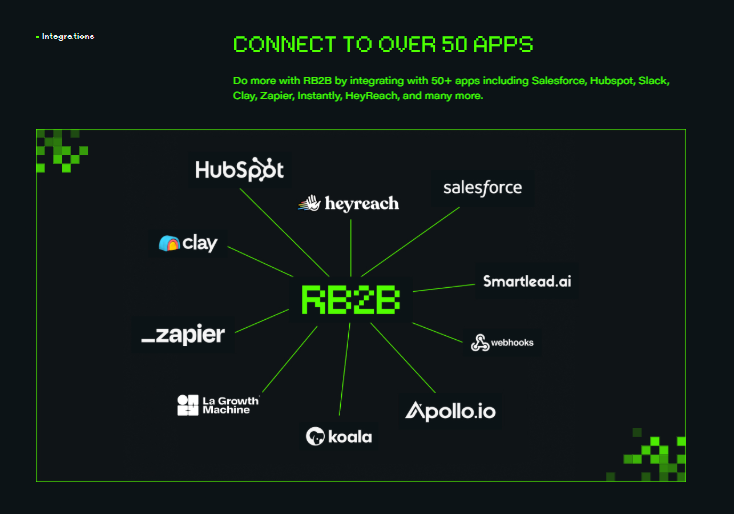
With all teams operating from the same real-time activity data, coordination improves further, and execution becomes more consistent. The result is not just better alignment, but a more efficient, unified ABM motion with fewer internal conflicts and faster pipeline progression.
A strong ABM system depends on timing, and timing depends on knowing exactly when an account shifts from passive interest to active buying behavior. This is where automated alerts become critical.
Install RB2B's pixel onto your website, and RB2B will track your high-intent pages, like pricing, demo, and product feature pages, and flag "hot leads," meaning accounts that match your ICP and are actively engaging with these key pages.

RB2B will then send real-time alerts directly to your team on Slack, Teams, or your CRM. This allows you to act immediately while interest is still high, rather than reaching out after momentum has dropped.
Getting alerts about hot leads is one thing; acting on them quickly is what determines whether they convert or go cold.
If your lead assignment or routing process is manual, valuable time gets lost between detection and action. By the time a rep is assigned, the account may already have lost interest or entered into conversations with a competitor.
This is why ABM systems like RB2B automate lead routing. Once a high-intent signal is detected, the lead is instantly assigned to the right rep based on product category, region, ICP tier, or language, without any delay.
ABM works as intended when teams can consistently distinguish between accounts that fit and accounts that are actually ready to buy. Without that visibility, even well-designed ABM programs fall back into guesswork.
RB2B closes that gap by adding real-time intent data to every ICP account, showing which target accounts are visiting your site, what they engage with, and how often. For teams serious about high-performing ABM, enriching ICP accounts with company- and individual-level intent data through RB2B makes the difference.
Want to run ABM based on real buyer behavior, not assumptions? Sign up to RB2B for free and start seeing which accounts are actively in-market today.
Alert your reps, start automated outreach, and add to lead score in under five minutes.

