
RB2B AI: ASK US ANYTHING
This guide covers ten sales prospecting techniques for B2B sales and marketing teams, from referrals and account-based prospecting to website visitor identification. Learn when each method works, how to apply it, and which signals deserve a closer look. The goal is more qualified conversations and booked demos, with less time spent on poor-fit contacts.
You send a hundred cold emails and hear back from two. Most were never in-market, so your effort vanished. Volume-based outreach burns time and goodwill. It treats every contact as equally likely to buy. Modern sales prospecting techniques fix this by starting with intent.
Sales prospecting is the process of finding potential customers, assessing their fit, and starting conversations that could become sales opportunities. In B2B, that often means researching both an account and the people involved in its buying decisions.
Buyers can research products, compare vendors, and read customer reviews before speaking to a rep. Prospecting should account for that research, while still reaching suitable accounts that have not visited your site.
Start with your ideal customer profile (ICP), then assess intent. The right role at a suitable company tells you who could benefit. Recent activity helps you judge when to reach out. Repeat visits to pricing and product pages give you more context than a single blog visit.
Combine those signals with established outreach methods. Good sales prospecting software helps surface and prioritize potential buyers; your team still needs to validate their needs and start a useful conversation.
Each technique below comes with a quick read on where it works, where it struggles, and how to get more from it. Treat it as a menu, not a checklist.
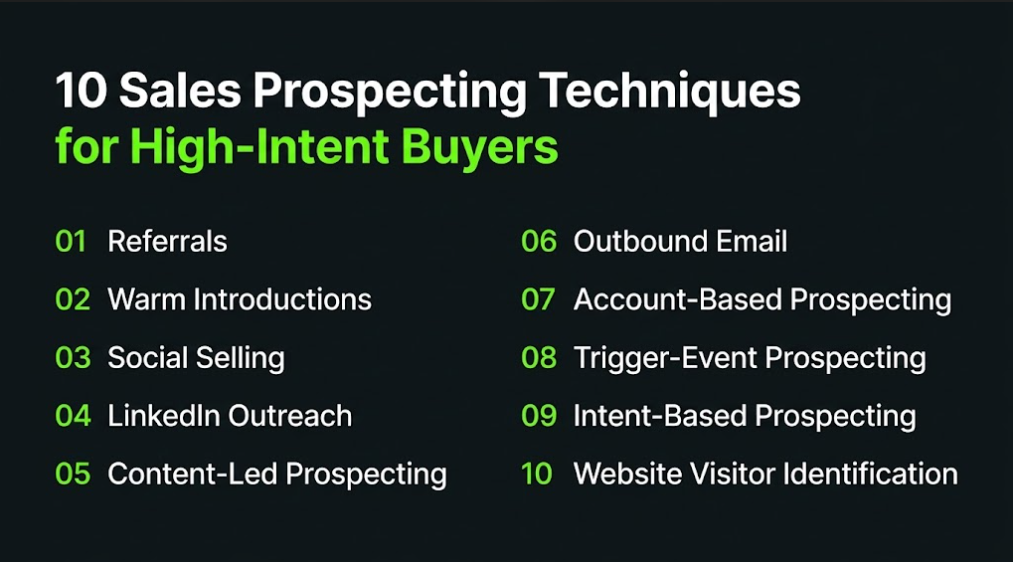
Referrals connect you with potential buyers through customers who know your work. A recommendation can make the first conversation easier, although you still need to establish fit and buying readiness.
When it works best: Ask after delivering a clear result, when a customer can explain the value you provided to a relevant peer.
Limitations: You cannot generate them on demand. Volume stays low, and every referral depends on a relationship you have already earned.
How to maximize it: Name the role or company you want to meet. For example: "Do you know another revenue leader whose SDRs struggle to prioritize inbound interest?" Give the customer a short note they can forward, and track referrals in your B2B lead generation process.
A warm introduction connects you through a mutual contact, such as an adviser, former colleague, or partner. Unlike a customer referral, the connector may know both parties without having used your product.
When it works best: It works best when you are pursuing one specific account. The right mutual connection bridges the difficult first step.
Limitations: You need a genuine, relevant connection to start. A forced introduction can do more harm than good, and your network sets the ceiling.
How to maximize it: Match target accounts against your network and your team's. Explain why the conversation could benefit the prospect, then give your connector a short message to forward. Ask whether they are comfortable making the introduction before naming them in your outreach.
Social selling means showing up where your buyers spend time and being worth following. You build trust steadily, long before any pitch. Buyers get to know you at their own pace.
When it works best: It works best as a long-term habit. Consistent value pulls buyers toward you over time. It suits founders and reps with a clear voice.
Limitations: Results are slow and hard to attribute. A single viral post will not fill a pipeline.
How to maximize it: Answer questions your buyers raise in posts and comments. If a sales leader discusses slow follow-up, share a practical routing tip. For example, suggest sending repeat visits from target accounts to the account owner. Follow up privately when you have something useful to add.
LinkedIn outreach helps you contact relevant professionals using context from their role, company, posts, and shared connections. Its usefulness depends on whether your buyers are active on the platform.
When it works best: It works best for considered, professional purchases. A relevant note can start a real conversation. Warm, researched outreach beats mass connection requests.
Limitations: Inboxes are crowded, and a connection acceptance does not establish buying intent. Generic pitches and repeated unsolicited messages can hurt your reputation.
How to maximize it: Lead with a relevant business issue. For example: "Hi Alex, I saw you’re hiring two SDRs. How are you deciding which inbound accounts they should contact first?" Check that the trigger is accurate before using it. Keep the first note brief; see our LinkedIn lead generation guide for more approaches.
Content-led prospecting uses useful content to support a targeted sales conversation. Publishing can attract potential buyers, while reps can also share relevant articles, checklists, or examples with accounts they are already pursuing.
When it works best: Use it when buyers need help understanding a problem or evaluating approaches. A resource that answers a specific question gives a rep a useful reason to follow up.
Limitations: Creating strong content takes time, and reading it does not necessarily indicate purchase intent. Organic traffic can take months to build, although reps can use existing content in outreach immediately.
How to maximize it: Match the resource to the prospect's problem. If an operations lead mentions missed follow-ups, share a lead-routing checklist and ask which step causes delays. For identified website visitors, assess account fit and the pages viewed before deciding whether a sales conversation or further nurturing makes sense.
Outbound email lets you contact relevant buyers at scale, but effective campaigns still require research, reliable contact data, sending infrastructure, and follow-up time.
When it works best: When the message is genuinely relevant. A clear, useful reason to reply outperforms clever copy. Precise targeting makes the difference.
Limitations: Poor-quality contact data, irrelevant messages, and excessive sending can damage deliverability and waste effort. Check contact accuracy and suppress unsubscribed or unsuitable recipients before launching a campaign.
How to maximize it: Group prospects by a shared need, then use a trigger that explains why you are reaching out now. If a company is expanding into Europe, a localization provider could ask how it plans to adapt its sales materials. Keep one clear ask and adapt these cold email templates to the situation.
Account-based prospecting goes deep, not wide. You choose a short list of ideal accounts and pursue each one with real focus.
When it works best: It works best for high-value, complex deals. Multiple stakeholders make the extra effort worth it. It aligns sales and marketing on shared targets.
Limitations: It is expensive and hard to scale. The wrong account list wastes the real budget. And when sales and marketing disagree on that list, the whole program stalls before it starts.
How to maximize it: Build the list from traits shared by your best customers. Map likely users, budget owners, and other stakeholders, then tailor outreach to each role. For example, a sales manager may care about rep workload while RevOps focuses on routing and CRM data. Use ABM software to coordinate account activity, and research stakeholders whose identities are still missing.
Trigger-event prospecting is a question of timing. Reach a company soon after something changes, and a cold contact suddenly has a reason to engage.
When it works best: It works best immediately after a relevant event. New funding, rapid hiring, or a new executive can each open a door. The event gives you a natural opening line.
Limitations: You need a reliable way to detect relevant changes. A funding announcement or new executive does not automatically mean the company needs your product or has budget allocated to it.
How to maximize it: Match the event to a problem you solve. A new sales leader may be reviewing pipeline quality or rep productivity. Check for supporting context, such as hiring plans or a stated priority, before using that angle. Repeat visits to commercial pages can add context; see our guide to identifying high-intent leads.
Intent-based prospecting uses research and engagement signals to prioritize outreach. These signals help you make a better-informed judgment about interest; they do not confirm a buying decision.
When it works best: Use it when you can combine recent, relevant activity with a strong ICP match. First-party website activity shows engagement with your own content, while other sources may help reveal broader category research.
Limitations: Signals can be incomplete, ambiguous, or tied to an account rather than a specific person. Third-party topic research may not indicate interest in your product, and your own visitors may be customers, competitors, or job seekers.
How to maximize it: Set a simple priority rule. An ICP-fit prospect returning to pricing and product pages goes to a rep for review. A suitable contact reading an introductory article may need more nurturing. Check the contact’s role and recent account activity before outreach. Refine these rules using qualified conversations and pipeline, rather than assuming every visit has equal value. Learn more about using intent data.
Website visitor identification reveals people or companies behind some of your anonymous traffic. At RB2B, we help B2B sales and marketing teams turn those matches into alerts, lead scoring, and outreach workflows. Reps get a contact to research and context for starting a conversation.
When it works best: Use it when your website attracts relevant potential customers and your team can qualify and follow up with suitable matches. It complements traffic from content, campaigns, and other prospecting activity.
Limitations: You need relevant website traffic, and not every visitor can be identified. Our person-level identification covers US traffic. Our global company-level identification is powered by Demandbase. A matched visitor still needs to be assessed for fit and buying readiness.
How to maximize it: Install our lightweight pixel and connect Slack, Microsoft Teams, or your CRM. For matched US visitors, we can surface LinkedIn profiles, job titles, and email addresses. Filter for your ICP, check the pages viewed, and route suitable contacts to a rep. Follow up promptly with a relevant question about their business, rather than describing their browsing history. Learn how to identify anonymous website visitors.
Ten techniques can feel overwhelming at first. You do not need all of them. Start with the few that fit your business.
Match the technique to your deal and your market:
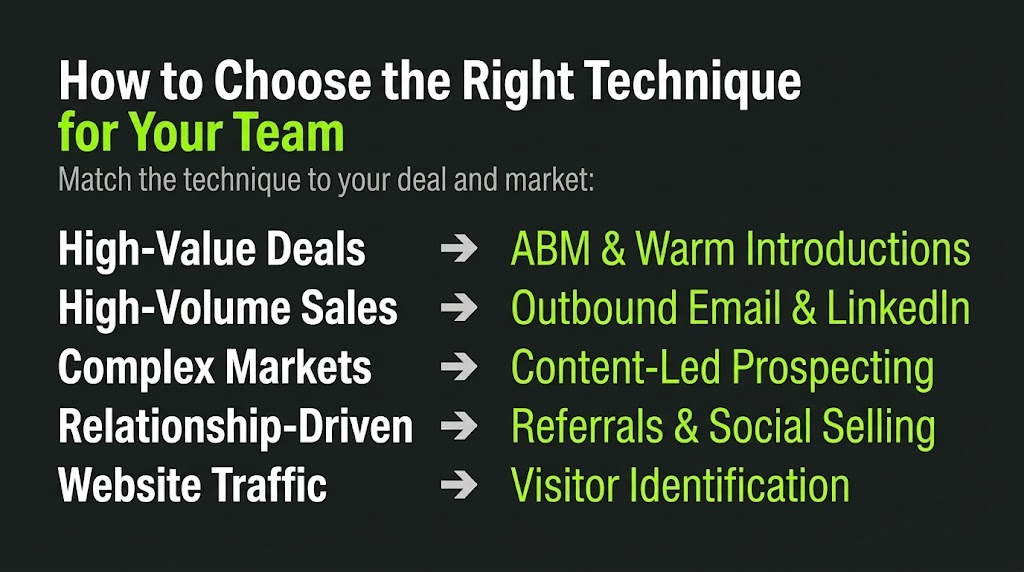
Also match each technique to your strengths. A strong founder brand favors social selling. A large, happy customer base favors referrals. Play to what you already have.
Choose two or three techniques your team can execute consistently. Add intent signals where available to help prioritize accounts, without excluding suitable prospects simply because you cannot observe their research.
Review operational results monthly and assess pipeline over a period that reflects your sales cycle. Adjust the mix when a technique consistently underperforms after a fair trial.
Combine identification, qualification, and outreach in one workflow, with a clear owner for the next action.
Use intent data to help decide which accounts to review first. Then choose an outreach method based on the prospect's role, likely need, and your existing relationship.
For example, consider this sequence:
The website signal starts the workflow; the rep decides the next step. For a new prospect, that may be a short question about a relevant problem. For an open opportunity, it may be a follow-up on an earlier discussion. Check recent outreach first so the buyer does not receive duplicate messages.
Our Hot Leads feature tags visitors who match your ICP criteria, such as company size, revenue, seniority, and department. Hot Pages helps you focus on activity around important content, including pricing pages and product demos. Through our HubSpot and Salesforce integrations, you can alert the account owner, update a lead score, or trigger an outreach workflow.
No. Referrals, calls, and email can still create opportunities with buyers who have not visited your website. Fit, relevance, and execution matter even when observable intent data is unavailable.
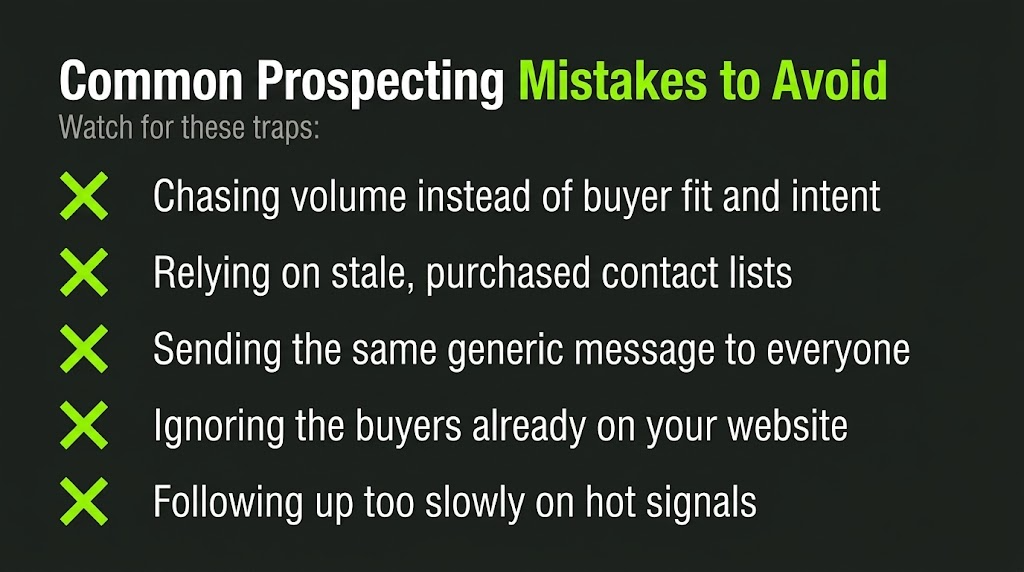
A few habits quietly drain your prospecting results. Watch for these traps:
Use these checks before launching a campaign and when reviewing a weak-performing technique. Investigate whether the problem is targeting, messaging, timing, or execution before changing channels.
Measure whether prospecting creates worthwhile conversations and opportunities. Activity counts help diagnose effort, but they do not show whether that effort produces revenue.
Watch a few numbers per technique:
Compare results for similar prospect groups and time periods. Record both the source of a lead and the channel used to contact it: visitor identification may surface a prospect who later replies by email. Keep attribution consistent to avoid counting the same opportunity twice.
For high-priority signals, set a follow-up target your team can meet and track whether faster responses improve qualified conversations. Prompt outreach helps only when the contact and message are relevant.
Review execution monthly, but allow for your sales cycle before judging pipeline and revenue. Use the findings to improve targeting and follow-up before increasing volume.
Choose a small mix of techniques that fits your market, then give reps a clear process for researching accounts, assessing signals, and starting relevant conversations.
RB2B helps you identify the people and companies already visiting your website and send those signals into your team’s workflow. Use them to prioritize outreach, book qualified demos, and give account owners context for their next conversation.
Want to put your website traffic to work? Watch the RB2B demo to see how visitor identification can support your sales team, then explore the free signup option.
The most effective B2B prospecting technique depends on your target market, deal size, and available resources. Referrals suit teams with strong customer relationships, while account-based prospecting suits complex deals involving several stakeholders. Use relevant intent signals to prioritize outreach, then compare techniques by qualified opportunities and pipeline created.
Cold outreach remains useful for B2B sales when it targets suitable prospects with a message tied to a relevant business need. Research the account, explain why you are reaching out, and make one clear request. A prior website visit is not required, though relevant buying signals can help improve timing.
To find high-intent B2B buyers, combine a strong ideal customer profile match with recent buying signals, such as repeat visits to pricing and product pages. Website visitor identification can help reveal people or companies behind that activity. Check the contact’s role and confirm their needs through conversation before treating them as sales-ready.
A practical starting point is two or three sales prospecting techniques that fit your target market and team capacity. Give each technique a clear owner, target audience, and measurable outcome. Evaluate qualified conversations and pipeline over your sales cycle before adding more methods or reallocating effort.
Alert your reps, start automated outreach, and add to lead score in under five minutes.

