
RB2B AI: ASK US ANYTHING
Lead Forensics is a well-known website visitor identification tool. It helps businesses discover which companies are browsing their site. If you’re exploring options like this, you’ve likely asked yourself: “How much does Lead Forensics cost?”
The answer isn’t straightforward. Pricing can range from $6,000 to nearly $100,000 per year, depending on many factors.
In this guide, I’ll break down Lead Forensics’ pricing structure (which isn’t easy to find), detail the features you actually get, and compare it to more affordable alternatives like RB2B, 6sense, and Leadfeeder. By the end, you’ll know how to identify real individuals who visit your site, complete with names, job titles, and verified emails. All that without paying an enterprise-level price.
Lead Forensics is a B2B website visitor identification tool that reveals which companies visit your website, even when they don't fill out a form. It's been around since 2009 and has built a reputation as one of the more established players in the visitor tracking space.
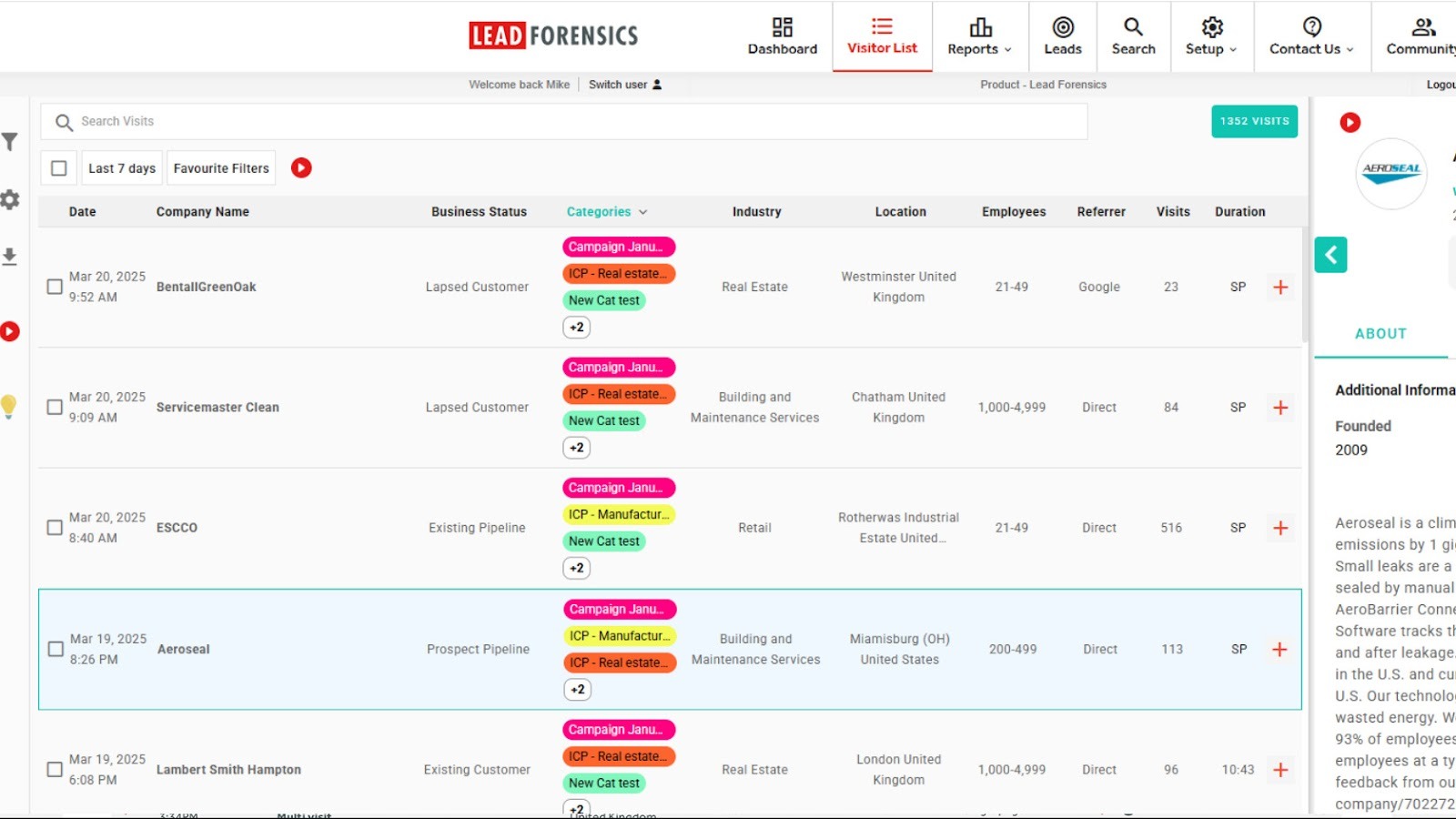
The platform uses IP tracking technology to match your website visitors to a proprietary database of businesses. From there, it provides firmographic data like company name, industry, employee count, and location. You can see which pages visitors viewed, how they found your site, and when they were most active.
Lead Forensics also integrates with CRMs like Salesforce, HubSpot, Pipedrive, and Microsoft Dynamics, allowing you to push identified companies directly into your sales pipeline.
However, Lead Forensics only provides account-level identification. You'll know Microsoft visited your site, but you won't know if it was Sarah in Marketing, John in Sales, or Liz from IT. Until someone fills out a form, you're stuck guessing who to contact.
For modern B2B sales teams that need to reach out to specific decision-makers, this is a HUGE gap.
Lead Forensics makes it incredibly difficult to find out what their platform actually costs. You’ll have to contact sales to find out.
Here's what I've pieced together from third-party data, customer reports, and other data:
According to Vendr's analysis of 47 real contracts, Lead Forensics pricing starts at approximately $6,000 annually and can reach up to $98,000 per year. The average cost most businesses pay is around $17,000 annually, though this varies significantly based on website traffic volume.
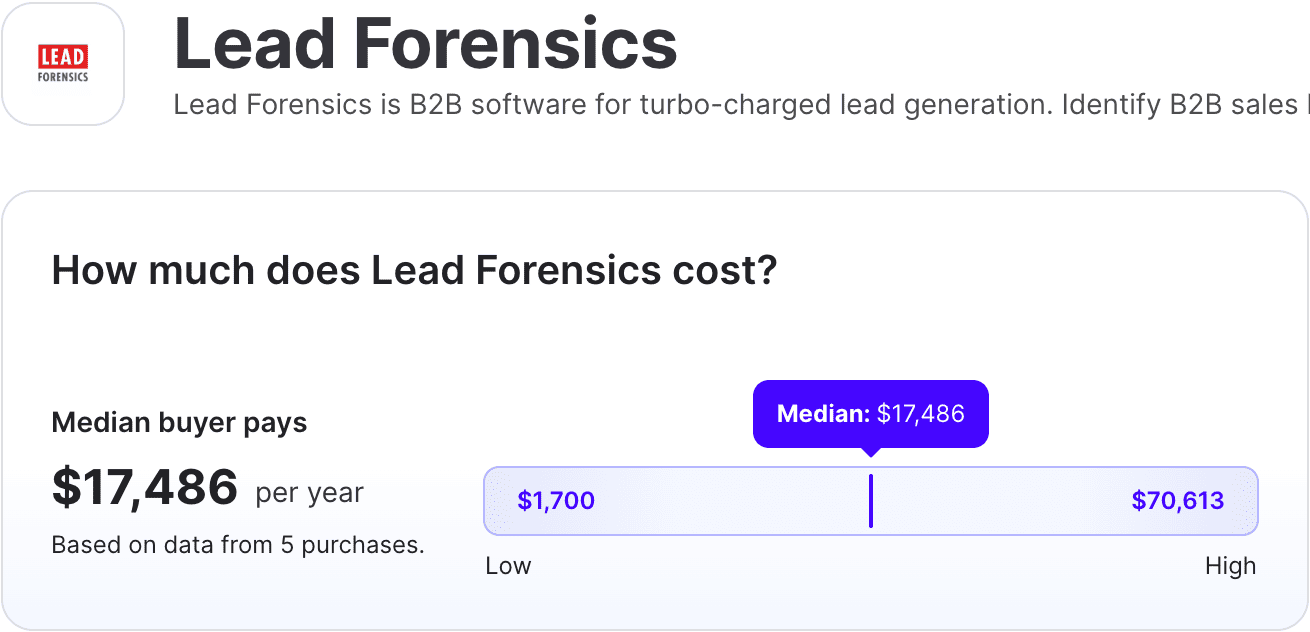
Lead Forensics uses traffic-based pricing, meaning your final cost depends heavily on:
Lead Forensics offers 2 main plans: Essential and Automate.
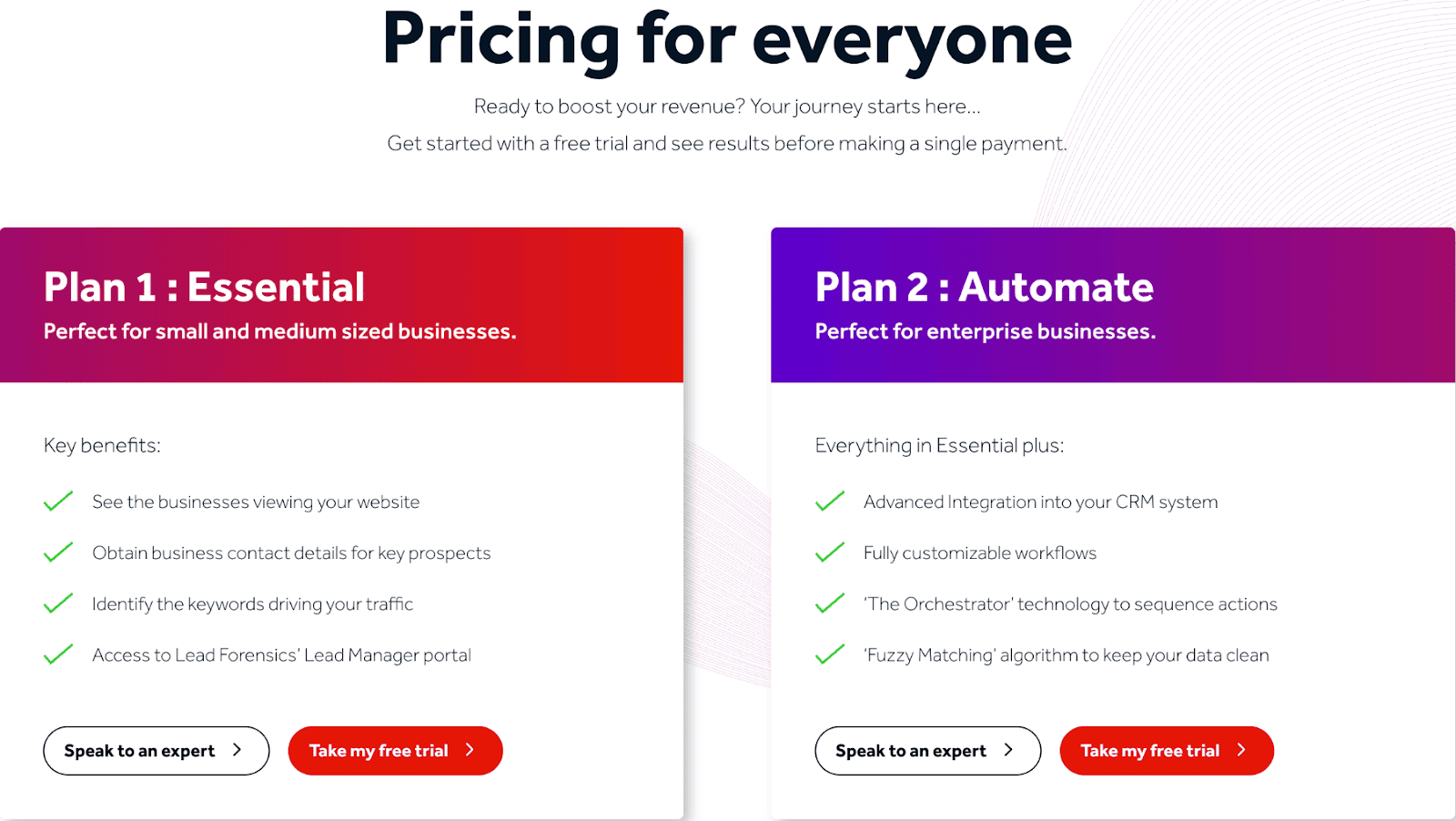
Both require you to go through their sales team for custom pricing, but here's what each includes:
The Essential plan is Lead Forensics' entry-level option, though "entry-level" is relative when we're talking $6,000-$25,000 annually.
Estimated cost: $6,000-$25,000/year.
The Essential plan works for small to medium businesses that just need basic company identification.
The Automate plan includes everything from Essential, plus enterprise-grade capabilities and more sophisticated integrations.
Estimated cost: $25,000-$98,000/year.
The Automate plan is designed for larger organizations with high website traffic and dedicated teams to manage the platform.
Lead Forensics does offer a 7-day free trial, but there's a catch: you MUST schedule a demo with their sales team first. You cannot access the trial without speaking to a representative.
At the end of the trial, the sales team will provide a custom quote based on your traffic volumes during that week.
Lead Forensics provides support through multiple channels:
Customer feedback on support is mixed. Some users praise the dedicated CSMs and responsive assistance. Others report frustration with slow response times during critical moments.
Lead Forensics focuses on company-level identification with enterprise pricing. RB2B takes a completely different approach: person-level identification at a fraction of the cost.
RB2B is a website visitor identification tool that goes beyond traditional company-level tracking to reveal the actual individuals browsing your site. It identifies visitors via cookies, device IDs, IP addresses, and Demandbase's Reverse-IP network.
What sets RB2B apart is its person-level tracking. You get full individual profiles, including job titles, LinkedIn profiles, and verified work emails for hyper-personalized outreach. The platform identifies 70-80% of U.S. website traffic at the person level, something Lead Forensics simply cannot do.
And when someone from your target accounts visits those key pages, you get real-time Slack alerts. The best part? You can try RB2B for FREE!
The price difference is wild. For what you'd pay for one year of Lead Forensics at the low end, you could run RB2B for nearly 4 years. Check out the breakdown below:
Lead Forensics and RB2B both help you identify website visitors. But which one actually delivers more value?
Lead Forensics tells you: "ACME visited your pricing page."
RB2B tells you: "Tim Doley, Director of Marketing at ACME, visited your pricing page, spent 3 minutes on your case studies, and checked out your integration docs."
With Lead Forensics, you waste days trying to find the right person at ACME.
With RB2B, you have Sarah's name, title, LinkedIn profile, and verified email ready to go. You can send a personalized message within minutes, not waste days hunting for the right contact.
Lead Forensics competes in a crowded market of visitor identification and ABM tools. Here's how some alternatives stack up:
6sense is an AI-powered ABM powerhouse that uses intent data and predictive analytics to identify which accounts are actively in-market. While Lead Forensics focuses on IP-based visitor identification, 6sense integrates with ad networks, CRM, and sales engagement tools to map the full buyer journey across multiple touchpoints.
Pricing: 6sense is significantly more expensive (typically $60,000-$100,000+/year), making it ideal for enterprise ABM programs with serious budgets.
Leadfeeder and Lead Forensics are often compared directly as they both focus on IP-based visitor identification. Leadfeeder tends to be more affordable and user-friendly, while Lead Forensics positions itself as more enterprise-focused with dedicated account management.
Pricing: Leadfeeder starts at €99/month (~$130/month), scaling with identified companies. Lead Forensics starts much higher at $6,000+/year.
If you have a substantial budget, Lead Forensics can make sense. It’s a better fit if you’re targeting large enterprise accounts and selling high-ticket solutions where account-level interest really matters. It also works well if company-level data is enough for your team.
On the flip side, Lead Forensics may not be ideal if you need person-level identification, have a tight budget, or prefer transparent pricing. It’s also a challenge if you want a fast setup or rely on modern, flexible automation without complex configuration.
Lead Forensics has been around since 2009 and has built a solid reputation. But for most B2B marketing teams, it's overkill with a price tag that's hard to justify.
Here's why RB2B stands out as a more practical alternative:
For small to mid-sized B2B companies or even larger organizations that prioritize person-level identification, transparent pricing, and faster implementation, RB2B delivers more actionable intelligence at a fraction of the cost.
Ready to identify actual individuals visiting your website, not just company names?
The RB2B setup process is straightforward—you only need to:
The basic version is 100% FREE to use, and you can explore additional features with a 30-day Pro trial. Get RB2B's Person-Level Website Visitor ID tool today and unlock detailed lead insights within minutes.
Alert your reps, start automated outreach, and add to lead score in under five minutes.

