
RB2B AI: ASK US ANYTHING
If you are evaluating whether Unify’s pricing aligns with your organization’s budget and delivers strong value, this article details its pricing model, credit system, and enterprise options. It also highlights limitations for small and mid-sized teams and explains why RB2B may offer a more cost-effective and efficient alternative.
Unify positions itself as an all-in-one market platform that combines intent data, AI-driven prospecting, and automated outreach in a single system. Its goal is to help revenue teams identify buyers faster and advance deals through the pipeline with reduced manual effort.
Unify aggregates signals from multiple data sources, enabling teams to identify accounts demonstrating buying intent and to conduct personalized outreach at scale. Sales and marketing teams can manage prospecting and engagement on one platform, eliminating the need for multiple tools.
While this approach can be efficient, the value depends on how extensively your team uses the platform. Unify offers a broad feature set, which may lead teams to pay for capabilities they do not need. The pricing is most justifiable for organizations fully committed to the platform and able to leverage its full range of features.
At RB2B, we help B2B teams convert anonymous website visitors into qualified leads within minutes. Our lead intelligence platform enables sales and marketing teams to identify 70–80% of website traffic at the individual level and deliver actionable data, including names, titles, emails, and LinkedIn profiles, directly into workflows like Slack or your CRM.
Unify offers three plans, but only the entry-level tier is publicly priced. There is no free tier. All plans include the same features, with the exception that enterprise subscribers receive SSO capabilities and a dedicated growth consultant.
Higher subscription tiers provide increased access to the same features, including more email-sending and platform users, additional credits, and more Active Plays.
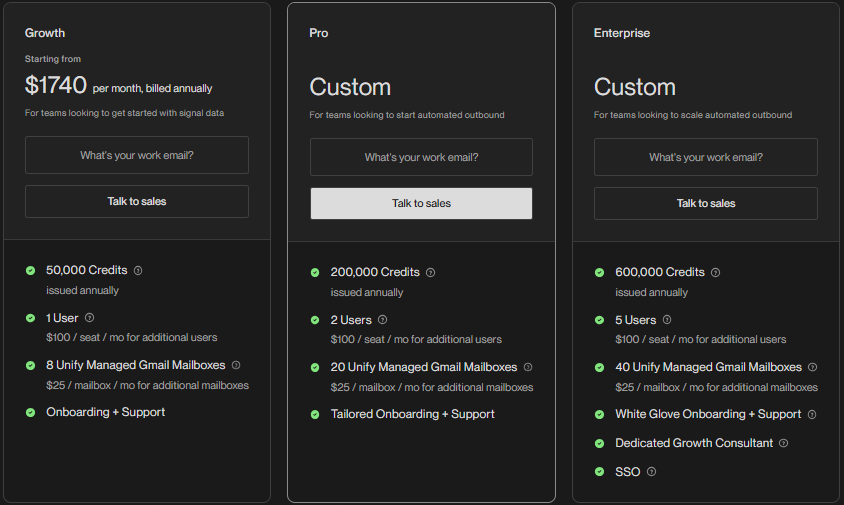
Unify’s Growth plan costs $20,880 per year. Although advertised as $1,740 per month, monthly billing is not available, so an annual payment is required. The Growth plan provides full platform functionality with a limited number of credits.
Unify’s Growth Plan includes:
The Pro plan features custom pricing and offers additional credits, more platform users, and more email-sending users. It is also billed annually and includes:
Like the Pro plan, the Enterprise plan has custom pricing. It primarily offers increased credits, more platform users, and enhanced security features.
The Enterprise plan gives you access to:
Across all tiers, Unify charges $100 per month per seat for additional users and $25 per month per mailbox for additional mailboxes.
Unify’s credit-based system charges you:
Please note that credit values may vary by provider, so these figures serve as a general guide rather than a standardized rate.
These are some of Unify’s most important features:
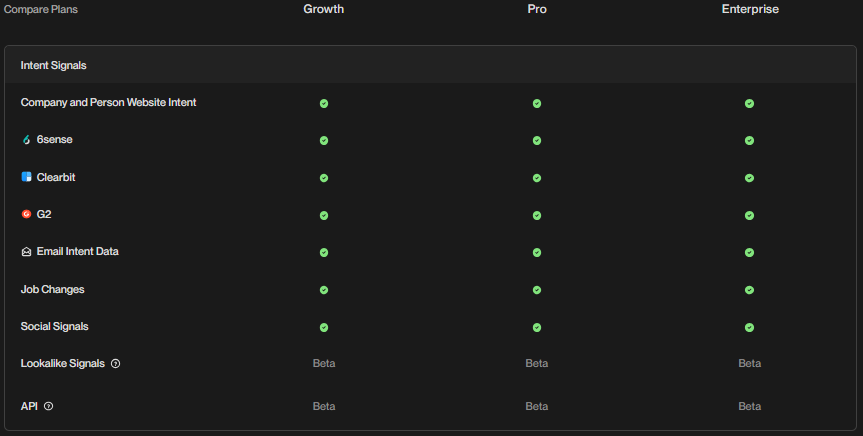
Unify tracks buying intent across multiple sources, including website activity, third-party data providers, and technology usage signals. This approach aims to identify accounts already demonstrating interest, rather than targeting cold leads.
For teams with sufficient traffic and data volume, this can help prioritize outreach. However, the effectiveness of intent data depends on its accuracy. Smaller companies may find it challenging to derive consistent value if signal volume is low or inconsistent.
The platform employs AI agents to research accounts and generate personalized outreach content at scale. It analyzes company websites, public business data, and firmographic details to create “smart snippets” for emails.
This can reduce manual research time and accelerate outbound efforts. However, human review remains necessary. The AI supports structure and context but does not replace strategic input, and overreliance may result in generic messaging.
Unify enables teams to build automated workflows, called Plays, which trigger actions based on intent signals. These workflows can include data enrichment, lead routing, and automated outreach steps that move prospects through the funnel.
For established go-to-market teams, this approach supports consistency and scalability. For smaller teams, it may introduce complexity. Effective setup requires initial effort, and ongoing value depends on regular maintenance and refinement.
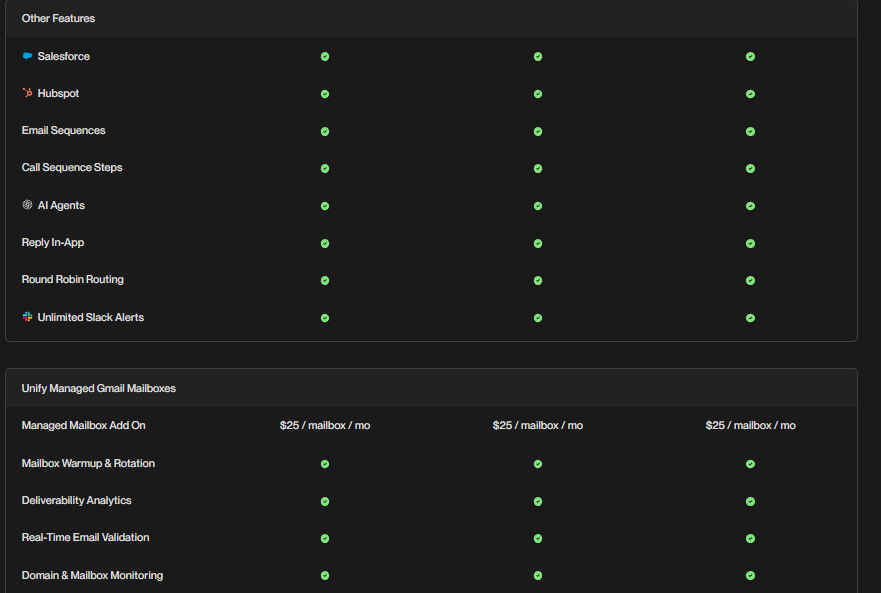
Email deliverability is managed within the platform through dedicated domains and mailboxes. Unify oversees technical aspects such as domain setup, inbox rotation, and deliverability safeguards.
This reduces risk for teams conducting outbound campaigns at scale but also increases dependency on the platform. For teams already confident in their deliverability processes, this feature may be redundant.
Unify offers reporting on intent activity, play performance, email engagement, and pipeline impact. Teams can monitor open rates, replies, and the contribution of automation to revenue.
The dashboards enhance visibility, particularly when all activities are managed within one system. However, many of these metrics are available in other tools. The key consideration is whether consolidation justifies the additional cost.
Areas Unify fall short of expectations in pricing are:
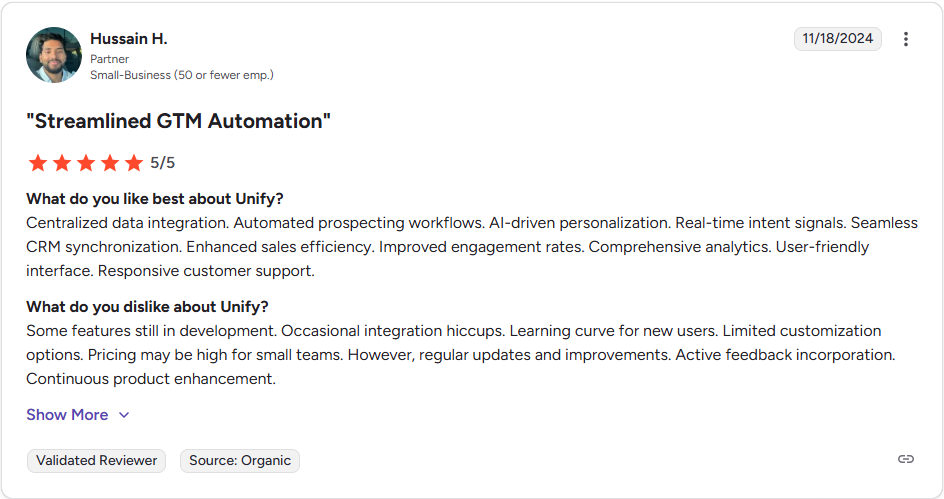
As of January 2026, Unify’s Growth plan starts at $1,740 per month, with annual payment required. This results in a significant upfront investment before realizing meaningful results.
For many early-stage companies, this requirement is prohibitive. Smaller teams often need flexible, lower monthly pricing. More affordable tools allow gradual scaling without substantial upfront costs.
Beyond base subscription fees, most actions—like revealing companies, emails, or phone numbers—use credits that you. This structure complicates budgeting, as credit limits may be reached sooner than anticipated, requiring additional purchases. A predictable flat rate is easier to manage. Tools like RB2B offer simpler pricing models with clearer cost expectations.clearer cost expectations.
The Growth plan limits users to two active Plays, which are the automations that drive prospecting and engagement.
This limitation is significant, as Plays are essential automation components. Teams may quickly outgrow this cap and be required to upgrade to higher, custom-priced tiers. More affordable alternatives typically do not restrict basic workflow automation as strictly.
Unify does not offer a free plan or even a limited trial version.
This is uncommon among competitors, many of which provide a free tier or short trial to evaluate the product before financial commitment. The absence of such options requires teams to commit funds without prior evaluation, which can be a barrier for organizations with limited budgets.
Even at higher price points, users report limitations in identification accuracy, de-anonymization, and integrations. Some intent signals and advanced identification features are described as weak or inconsistent.
Although Unify charges premium fees for a comprehensive platform, some core capabilities lag behind more specialized tools. This gap can make the cost difficult to justify, especially when alternatives like RB2B provide similar value at significantly lower prices.
For teams evaluating Unify primarily on cost, access, and long-term usability, here’s how RB2B and Unify compare in day-to-day use and how easily intent data can be activated across sales workflows.
RB2B offers a free, permanent tier that provides immediate value. Users receive 150 monthly credits, unlimited user access, and basic Slack alerts at no cost.
In contrast, Unify does not offer a free plan or trial and requires annual upfront payment. This compels small businesses to commit significant funds before realizing value, making RB2B a more accessible option for startups and lean teams.
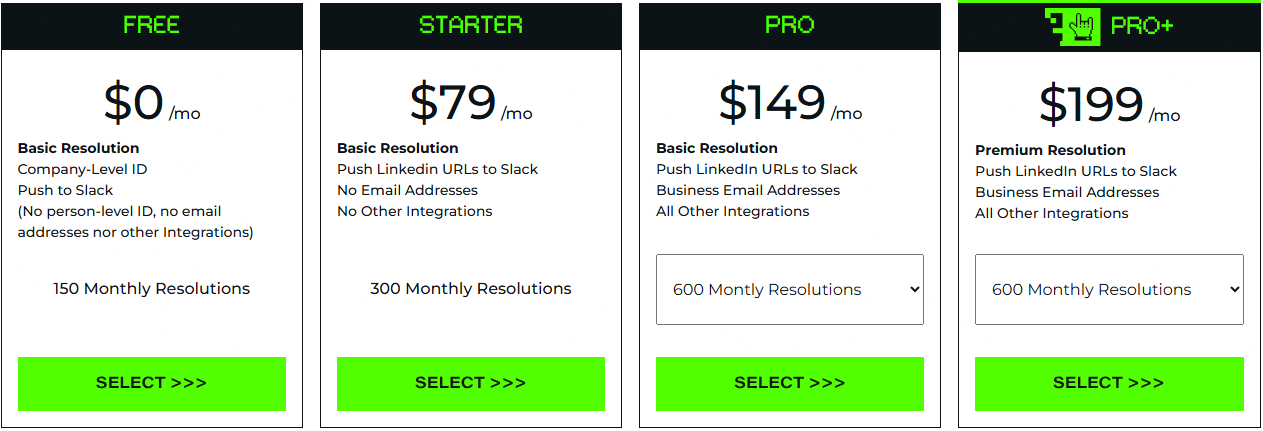
RB2B pricing allows for gradual upgrades. The Starter plan costs $79 per month, while the Pro+ plan is $199 per month, both including a 7-day free trial. Additional credits can be purchased as needed, with bulk credits available at a discounted rate.
Unify’s entry level sits much higher, and locks features behind expensive tiers. RB2B’s model means you can scale spend with growth, rather than burning cash before you know what works.
RB2B does not limit the number of users on the platform. Both free and paid plans offer unlimited user access.
Unify imposes strict user limits, even at higher tiers, requiring additional payment for extra seats. For growing sales and marketing teams, unlimited access helps maintain predictable costs.
Even on RB2B’s free tier, users receive real-time visitor insights delivered to Slack, along with profile data such as names, titles, and companies.
With Unify, essential identification features may be hidden or restricted to higher pricing tiers, and some signal types may be limited or inconsistent. As a result, users may pay extra for basic data that is standard elsewhere. Plans help teams prioritise the best leads without blasting through credits.
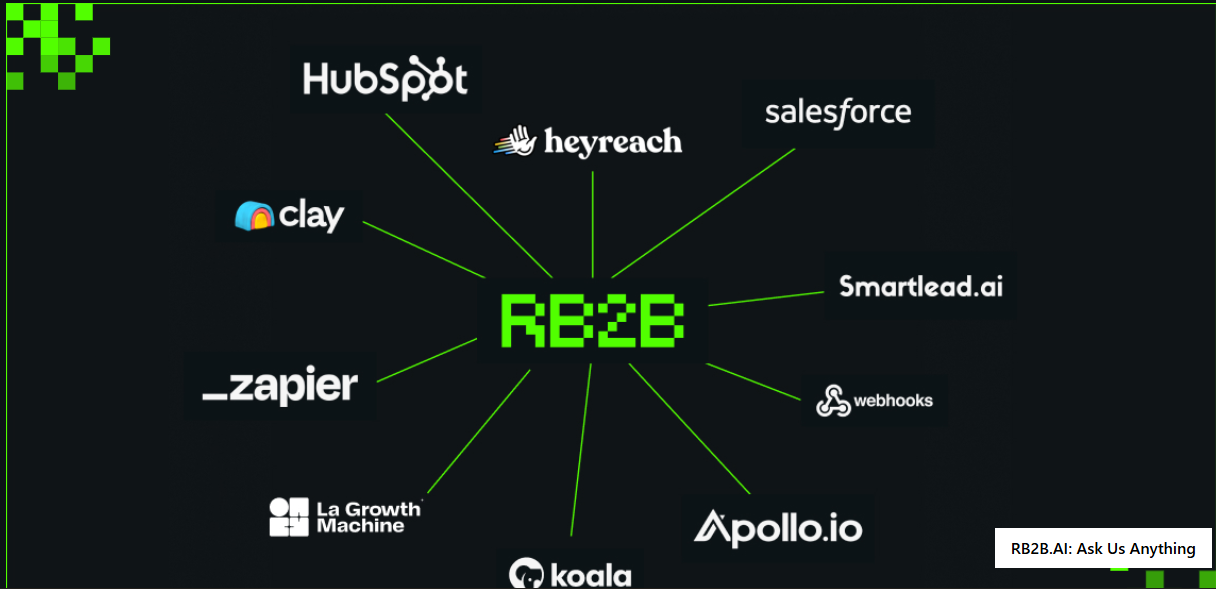
RB2B’s paid plans integrate seamlessly with major CRMs such as HubSpot, Salesforce, Apollo, Clay, and Zapier. This ensures data flows directly into your team’s existing systems without the need for complex integration work.
In contrast, Unify’s integrations are sometimes reported as less reliable, particularly when connecting to workflow automations. RB2B’s direct lead routing into sales tools is often considered more practical for teams focused on pipeline efficiency.
Unify works for teams with large budgets and complex GTM stacks. But for many growing businesses, the pricing, limits, and upfront commitments make it hard to justify. RB2B takes a different approach. It focuses on what teams actually need: clear visitor identification, strong lead data, simple workflows, and pricing that scales with usage.
If you’re looking for a GTM tool that’s easier to use, easier to afford, and easier to grow with, check out RB2B and see how it fits your business needs. You can start for free, involve your entire team, and only pay more when the value is clear.
Alert your reps, start automated outreach, and add to lead score in under five minutes.

