
RB2B AI: ASK US ANYTHING
If you work in sales or on a GTM team, you're likely familiar with the frustration of seeing clear signs of interest—rising website traffic, increasing demo or product page views, keyword surges—yet still not being able to tie those signals to a specific account or person.
As a result, every time you launch an outreach campaign, you're often starting with a generic list of buyers. That list might include someone who visited your site yesterday or a former salesperson who hasn't been in the workforce for years.
This is exactly why website visitor identification and lead intelligence tools are so important.
By turning high-intent signals into identifiable companies and contact information, these tools ensure your outreach is based on a database of in-market buyers, not just every account that fits your ICP on paper.
If you're in the market for a tool like this and you've landed on—or are curious about—Lead Forensics, this review is for you.
Here, we'll cover Lead Forensics' key features, pricing, pros, and cons. That way, you can decide whether it's the best option for your team or if an alternative like RB2B will serve you better.
Lead Forensics is a website visitor identification and lead intelligence tool that helps B2B growth teams uncover the corporate identities behind their website traffic.
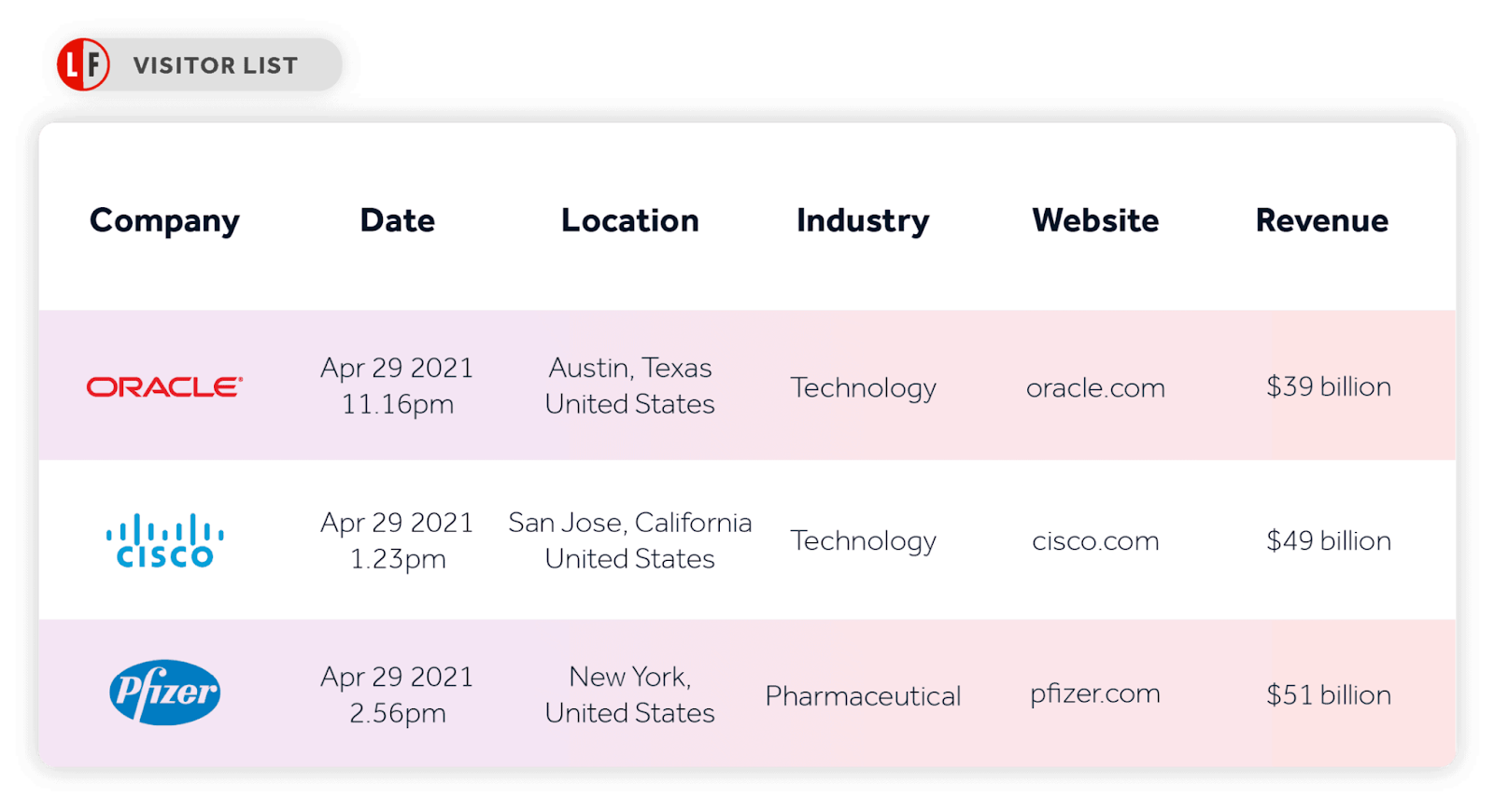
Lead Forensics works by matching website page hits against its large B2B database to identify the company IP address each visit came from. Using the ICP criteria you've defined, Lead Forensics then surfaces potential buyers from those companies—along with their names, job titles, email addresses, LinkedIn profiles, and phone numbers.
This data can be routed across your entire GTM team, regardless of how your workflows are set up.
For sales teams, Lead Forensics helps identify in-market and actively considering buyers, including prospects you didn't even know were engaging with your site. This enables more accurate, targeted outreach, rather than spraying messages across a broad, generic list.
Marketing teams benefit as well. With access to company and contact-level data, marketing can capture demand more effectively and run more specific, compelling, and account-based follow-ups.
Lead Forensics doesn't only help with new prospects, either. If you already have customers, you can upload your customer records and track when any of them revisit your website. This allows customer account management teams to deliver more proactive support or quickly identify cross-sell and upsell opportunities.
Additionally, Lead Forensics shows you which pages each visitor views, helping you distinguish between those who are simply exploring (for example, reading multiple educational blog posts) and those who are actively considering a purchase (such as repeatedly viewing your pricing page). This insight allows your team to prioritize outreach and follow-ups more effectively.
Lead Forensics' pricing isn't publicly listed. You'll need to contact their sales team for a quote. However, their pricing page mentions two paid plans: Essential and Automate.
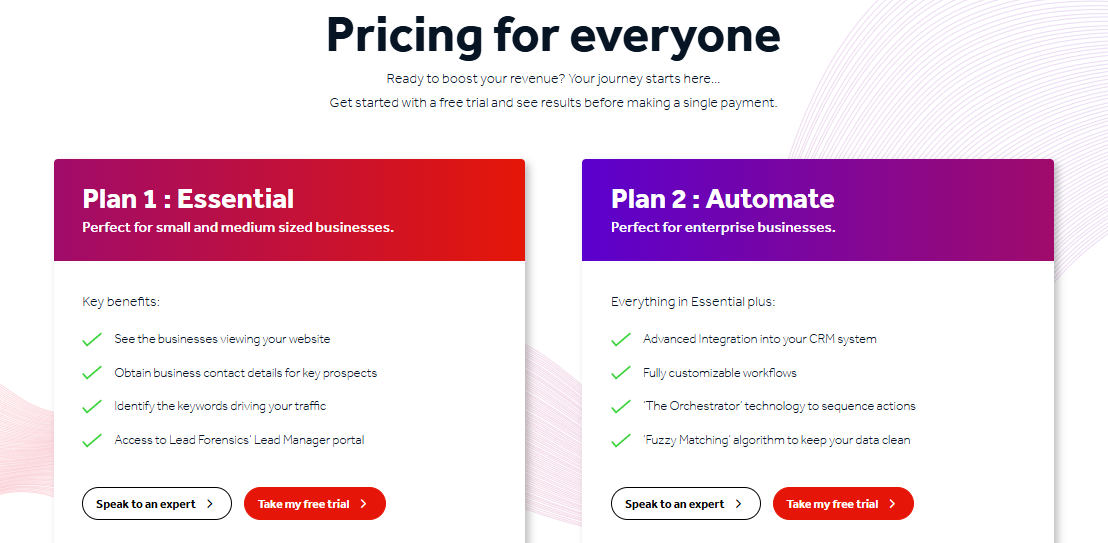
The Essential plan lets you:
The Automate plan includes everything in the Essential plan, plus advanced automation features that allow you to:
While the Automate plan is more expensive than Essential, your final quote will depend on factors like:
Lead Forensics doesn't offer a free plan, but both paid plans include a 7-day full-feature trial. One notable advantage is that pricing isn't seat-based—regardless of how many team members log in, you pay the same as long as your usage remains consistent.
As a rough estimate, marketplace reviews suggest that Lead Forensics costs an average of $17,000 per year and can reach up to $75,000.
⭐ 4.4 out of 5
As we've discussed, Lead Forensics empowers your sales, marketing, and customer management teams with deanonymized company-level website visitor data. It also provides email addresses, LinkedIn profiles, and phone numbers for potential ICPs within those identified companies.
But that's where it stops.
After you get your list of potential ICPs, you still won't know whether your website visitor matches any contact. And even if the visitor is on the list, you can't identify exactly who it is.
This means some level of generic pitching is still required, even though you're now targeting people within a single company. As a result, Lead Forensics' data can feel limited or, in some cases, unusable.
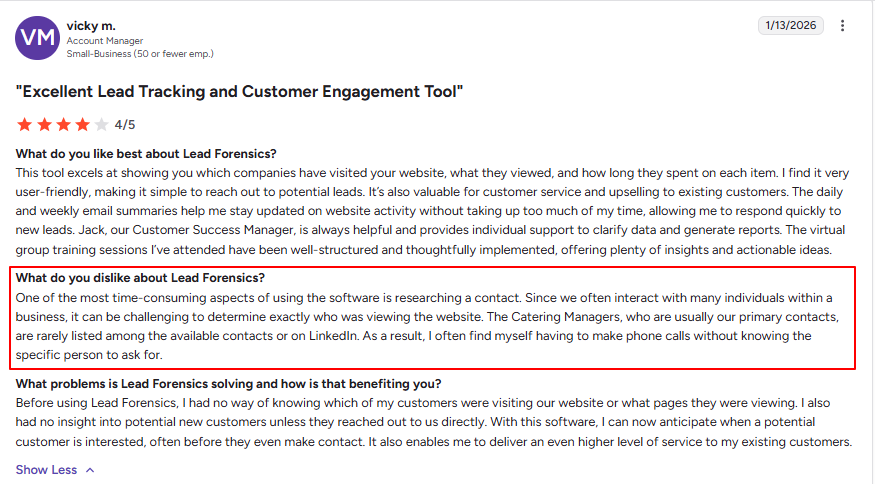
One G2 user explained the challenge:
"One of the most time-consuming aspects of using the software is researching a contact. Since we often interact with many individuals within a business, it can be challenging to determine exactly who was viewing the website…
…As a result, I often find myself having to make phone calls without knowing the specific person to ask for."
This is exactly the problem RB2B solves.
RB2B is a stakeholder-level website visitor identification tool that ensures B2B GTM teams don't have to guess which specific individuals visited their websites.
Unlike Lead Forensics, which tracks and matches only company IP addresses, RB2B's tracking pixels go a step further to identify not only the companies your visitors work at, but also their names, positions, teams, LinkedIn profiles, and email addresses.
This eliminates the need to collate all company ICPs and guess who your visitor might be. With RB2B, you know exactly who visited your site, allowing for targeted, individual-level outreach.
RB2B's website lead quality is also higher because it:
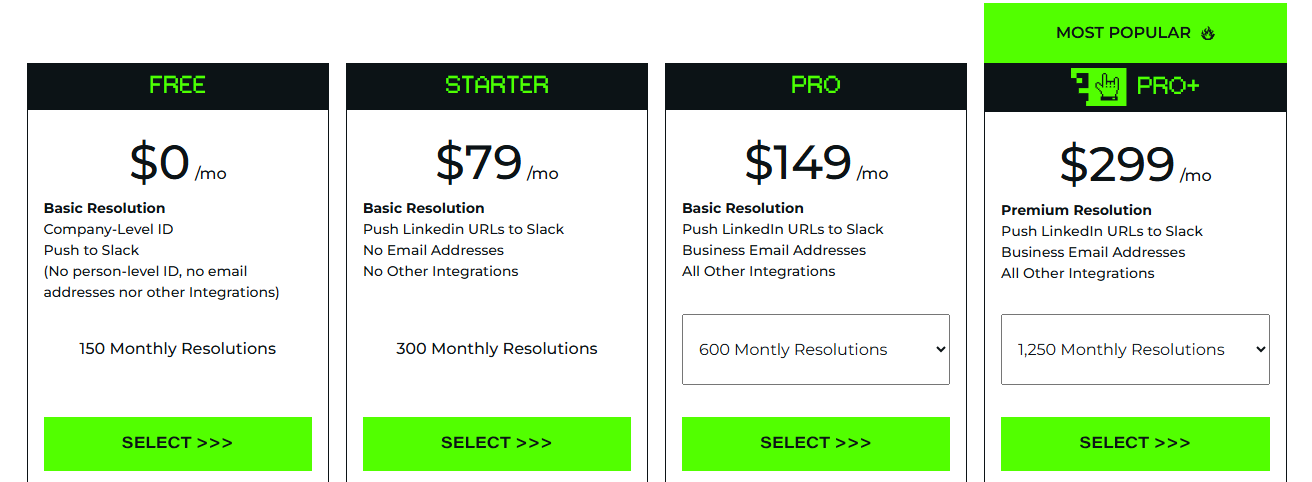
RB2B offers two main business plans: Pro and Pro+.
The Pro plan starts at $149/month, lets you identify between 600 and 2,500 website visitors per month and gives you full access to RB2B's infrastructure, with two exceptions—with two exceptions: Identity Graph Waterfall and additional contacts per ICP account.
The Pro+ plan includes these two features plus everything in the Pro plan, with pricing starting at $199/month.
For businesses with multiple websites, RB2B lets you connect up to five additional domains on either plan and access full features across all domains for $99 per domain per month.
RB2B also offers a Starter plan for $79/month, which lets you identify up to 300 website visitors per month. This plan is ideal for small businesses looking for an affordable lead intelligence tool.
All paid RB2B plans come with a 7-day full-feature trial, so you can test the platform before committing.
New to lead intelligence tools and want to try one risk-free? RB2B also offers a freemium plan that lets you identify up to 150 companies per month—forever. This flexible pricing structure allows RB2B to scale with your business. You can start with the free plan and upgrade as your traffic grows and your needs expand.
⭐ 4.5 out of 5
Want a quick, at-a-glance comparison of Lead Forensics and RB2B? This table highlights their key differences.
Still unsure which tool is the better fit, Lead Forensics or RB2B? Here are three RB2B advantages that are hard to overlook.
Lead Forensics, like most legacy website visitor identification tools, operates at the company level. RB2B doesn't.
In addition to company intelligence, RB2B provides individual-level data, so you don't have to guess whether the visitor from LinkedIn's San Francisco office was Bella from finance or Tim from sales. You know exactly who engaged with your site and can tailor your outreach accordingly.
Lead Forensics reportedly costs an average of $17,000 per year and doesn't offer a free plan, making it inaccessible for many small and mid-sized businesses.
RB2B, on the other hand, offers a freemium plan and a $79/month Starter plan, making it easy for teams with lower website traffic to get started.
As your business grows, you can scale to RB2B's Pro and Pro+ plans, which offer the same core capabilities as Lead Forensics—plus individual-level identification—at a fraction of the cost.
Lead Forensics limits integrations with tools like HubSpot, Salesforce, Pipedrive, Zoho CRM, and Microsoft Dynamics to its Automate plan, which can cost several thousand dollars per month.
With RB2B, you get access to all core integrations on the Pro plan for $149/month, without upgrading to an expensive enterprise tier.
Lead Forensics and RB2B both help B2B teams deanonymise website traffic, but they serve different needs.
If your priority is company-level visibility and you have a larger budget, Lead Forensics can help you understand which accounts are engaging with your site. However, its lack of person-level identification and higher cost can make it limiting.
RB2B takes a more modern approach. By identifying the actual individuals visiting your website, offering flexible pricing, and providing full integrations at a lower cost, it removes much of the guesswork from outbound and follow-up campaigns.
For most B2B teams—especially startups, SMBs, and growth-stage companies—RB2B is the more practical and scalable choice. You can start for free, prove value quickly, and scale as your traffic and GTM motion grow.
Try RB2B today with a 7-day full-feature trial and see the difference for yourself.
Alert your reps, start automated outreach, and add to lead score in under five minutes.

